
Reference
Soft refurb or full PIP: what a re-cover can rescue
A soft refurb replaces the carpet, window treatments, wallcovering, lamps, bedding and the fabric on the seating and keeps the carcasses standing. A full PIP replaces the case goods too: headboard, bed base, wardrobe, desk, nightstands, seating frames. Marriott's Autograph Collection contract renews the two tiers “periodically as required by our then-current standards”, and reserves the right, at any FF&E replacement, to require the rest of the hotel to be brought up as well.
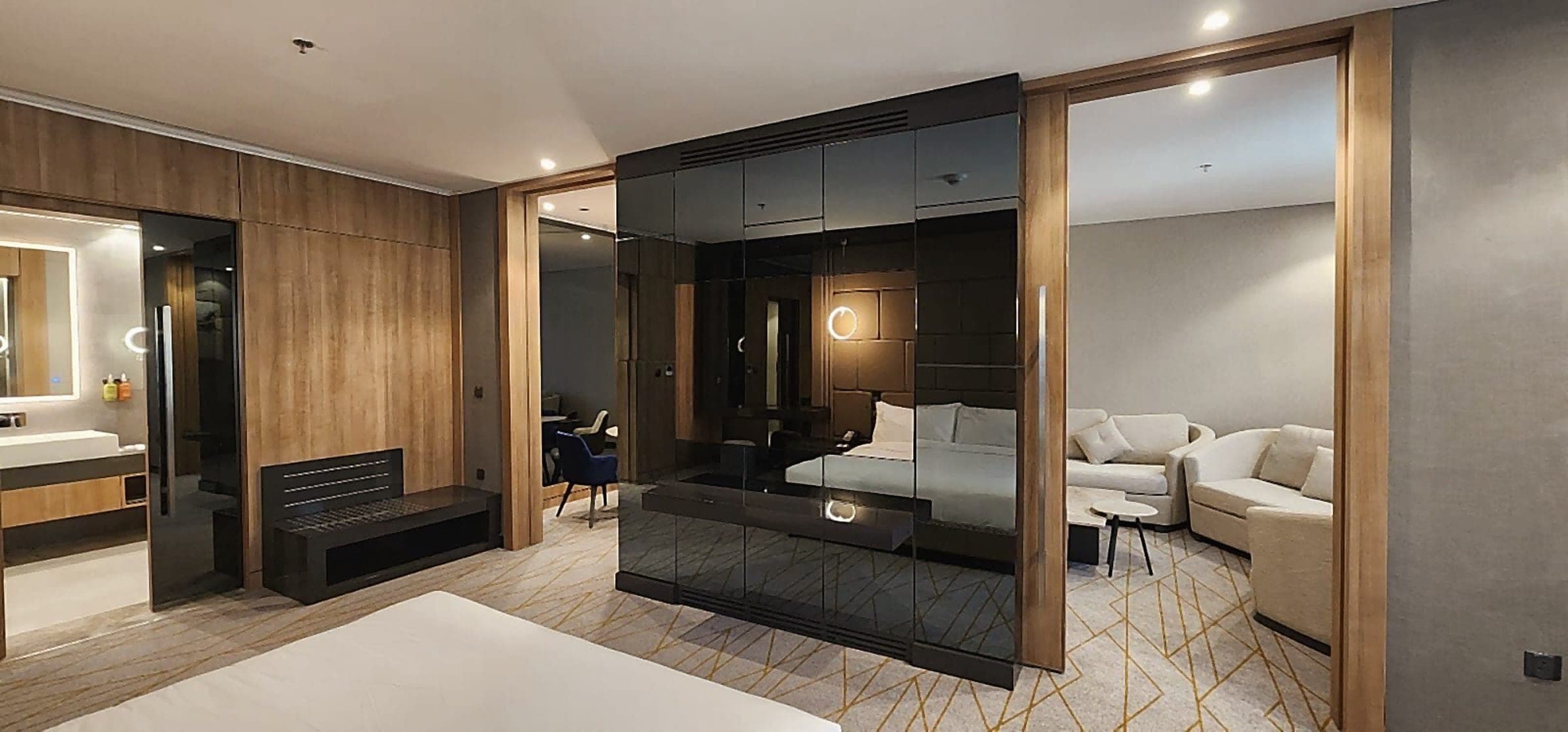
Owners stretch the case-goods cycle on purpose. Heather Carrasco of Coury Hospitality told Hotel Management in 2025 that “it doesn't have to be seven years before we replace something”, and that smaller, intermittent spending beats one lump sum. The brands stopped accepting deferral after the pandemic: “All the brands came in and said, ‘We've given you enough time to recover’”, Paul Novak of Whitman Peterson told CoStar in March 2024. Between those two positions sits the tier this page is about, the soft refurb, which the contracts name and most factories do not. What follows is what it contains, what it keeps, and what a bench can do with the pieces it keeps.
The two tiers, as the contract and the cost guide write them
| Soft goods pass | Case goods pass (the full PIP) | |
|---|---|---|
| What is replaced | Carpet and pad, window treatments, vinyl wallcovering, paint, lamps, artwork and mirrors, bedding, the fabric and foam on the seating | Everything in the soft-goods pass, plus the headboard, the bed base, the wardrobe or armoire, the desk, the nightstands, the dresser, the seating frames, the entry flooring and the television |
| Where the split is written | Nehmer and HVS Design's Hotel Cost Estimating Guide, 2024 edition: “Guestroom Softgoods Renovation” | The same guide: “Add for a Full Renovation”; Marriott's 2024 Autograph Collection contract: “case goods FF&E” |
| How the contract prices the difference | Marriott charges $30,000 when an owner retains an interior design firm off its recommended list “in connection with a soft goods renovation or PIP” | $50,000 for the same choice “in connection with a new-build project or case goods renovation or PIP” |
| What stays | The carcasses, the joinery, the bed base, the seating frames, the vanity cabinet | The building |
What a re-cover can rescue, and what it cannot
A lounge chair with a sound frame and tired fabric is a soft-goods item: the cover comes off, the foam is replaced to the fire standard the book names, the frame is checked at the joints and re-glued where it moves, and the chair goes back with a new cover. A chair whose frame has opened at the arm is a case-goods item wearing a soft-goods label, and re-covering it buys one season. The difference is found by hand, at the frame, before the fabric is ordered, and it is the first thing we ask to see.
A headboard wall is the item that moves a room most for the least demolition. The upholstered panel or the veneered panel comes off its cleat, a new one goes on, and the bed base beneath it stays. New tops on a desk and nightstands, stone or lacquer, do the same job at the working surfaces. New doors on a wardrobe carcass change the room's colour without touching the carcass, if the carcass was built square and the hinge positions can be kept. Those four moves are the soft-refurb tier from the bench: they touch what a guest sees and leave what a guest never opens.
What a re-cover cannot rescue is a carcass built to a board grade that has swollen at the base, a drawer box that has lost its runner, a minibar cabinet whose ventilation cut-out was never made, or a vanity whose top was set on a cabinet that has taken water. Those are case-goods items, and putting a new door on them is a full-PIP cost paid twice, once now and once when the PIP arrives.
The clause that lets the brand ask for the rest
Marriott's Autograph Collection disclosure states the obligation plainly: the owner “must accomplish a significant renovation of guestrooms, guestroom corridors, and public facilities, including the replacement of soft goods FF&E, and case goods FF&E periodically as required by our then-current standards”. The next sentence is the one to read twice: “At the time of any replacement of FF&E, we have the right to require you to upgrade the rest of the hotel to conform to the standards applicable to similarly situated Autograph Collection hotels.” A soft-goods pass is therefore also a moment at which the case-goods question can be asked.
Hilton's 2026 disclosure for Hilton Garden Inn carries the same mechanism under a different name: a “cycled renovation” the owner is responsible for, deadlines the brand sets “according to your PIP” in a conversion, a Past Due Design Fee of $5,000 every 90 days if acceptable plans and designs are not submitted on time, and a Brand Non-Compliance Fee of $65 to $145 per guest room for each consecutive unacceptable quality grade. The tier an owner chooses is his, and the calendar that follows it is written in the agreement.
How the tier is decided at the bench
The decision is made room by room, on one room. A soft-refurb quotation starts with a survey of what stands: the carcass grade and its condition at the base, the hinge and runner hardware, the frames of every upholstered piece, the tops. The survey sorts the room into what is re-covered, what is re-topped, what gets new doors, and what is replaced, and the quotation prices those four lists separately so an owner can move an item between them.
One key is then built or re-fitted as the mock-up, with the kept carcasses in place and the new headboard wall, tops, doors and covers on them, and it is approved by the owner and the designer before the floor is released. Where a brand book applies, the book's sample and submittal stages run inside that same room. The soft-goods tier is still a programme: it has a sequence, a sample stage and a sign-off, and the difference from a full PIP is what leaves the room, not how the work is run.
Asked most
- What is a soft refurb in a hotel?
- A renovation pass that replaces the soft goods, meaning carpet, window treatments, wallcovering, paint, lamps, bedding and the fabric on the seating, and keeps the case goods: headboard, bed base, wardrobe, desk, nightstands and seating frames. Nehmer and HVS Design's Hotel Cost Estimating Guide prices it as its own guestroom tier.
- Can a soft refurb satisfy a PIP?
- Only if the PIP asks for soft goods. Marriott's Autograph Collection contract renews soft goods FF&E and case goods FF&E “periodically as required by our then-current standards” and reserves the right, at any FF&E replacement, to require the rest of the hotel to be upgraded. Which tier a PIP asks for is in the PIP.
- What can be kept in a guest room and what has to go?
- Kept, if sound: the carcasses of the wardrobe, desk and nightstands, the bed base, the seating frames and the vanity cabinet. Replaced: fabric and foam, tops, doors, the headboard panel, and any carcass that has swollen at the base or lost its hardware. The sort is done by hand on one room before the quotation.
Related
Deciding between the two tiers?
Send photographs of one room and the PIP list if there is one. We tell you what the room can keep, what it cannot, and price the two tiers side by side on the same drawing.
Send the BOQ. Get a factory-direct number