
Reference
What a lead time contains
A quoted furniture lead time covers one segment of a six-part clock. The six: purchase-order approval, shop-drawing and submittal review, finish and fabric approvals, production and finishing, consolidation and clearance, transit and delivery. Only production is the factory's to hold. By the hauliers' published tables, road runs 5–7 days door to door to Germany, the Netherlands and the UK; ONE's 2024 published NTX sheet gives Gemlik to Rotterdam in 20 days by sea.
Mitch Parker of Parker International writes the grievance down in one sentence: "There is a misconception that vendor lead times quoted at 12 weeks means delivery in 12 weeks. The vendor's lead time does not consider the time needed for PO approval, shop, finish and cutting approvals, and delivery time." A figure quoted by a factory covers the factory's own segment. The segments on either side of it belong to the buyer, the design team, the fabric mill, the forwarder and the customs broker. This page names all six, says who holds each one, and gives the published number where a published number exists. There is none for ours and this page does not invent one: we quote a current estimate against the production plan, and report it when it moves.
The six parts of the clock
Read the second column first. Five of the six segments are wholly or partly somebody else's, and three of the six carry a figure a third party has published and anyone can check. The other three carry no figure, and this page says so rather than filling them in.
| Segment | Who holds it | What moves it | The published figure, where one exists |
|---|---|---|---|
| Purchase-order approval | The buyer, and whoever signs on the owner's behalf | How many signatures a PO collects, and whether the deposit clears with it | None published. Parker names it first among the things a quoted lead time excludes |
| Shop-drawing and submittal review | The design team | The number of review rounds; two on a first submittal is ordinary | Five working days per review round and five more for a resubmittal, published in the Beloit Procurement Services package |
| Finish, fabric and cutting approvals | The design team, against samples we make | Strike-offs, CFAs, and the mill's own delivery of the bolt | None published. Laurie Dietrich of The Ness Group: "Fabrics and submittals ALWAYS take much longer than anticipated" |
| Production and finishing | Us, in Gemlik | Scope, materials, the finish schedule, and what the production plan already holds | None. A current estimate against the production plan, reported when it moves |
| Consolidation and clearance | The freight forwarder and the customs broker | Whether the order ships as one consignment, and which proof of origin the destination wants | arcedior's FF&E sourcing FAQ tells buyers to add 2-4 weeks for consolidation and customs clearance on cross-border projects from India, China, Turkey or the UAE |
| Transit and delivery | The carrier or the haulier, and whoever receives on site | Route, sailing frequency, and the Kapıkule border queue | By road, published haulier tables give 5–7 days door to door to Germany, the Netherlands and the UK. By sea, ONE's 2024 published NTX sheet gives 17 days to Felixstowe, 18 to Antwerp, 20 to Rotterdam and 23 to Hamburg |
What the quoted figure leaves out
Parker's sentence names five things, and a factory's figure covers none of them: purchase-order approval, shop-drawing approval, finish approval, cutting approval, delivery. Four of the five sit with the buyer and the design team. That is the uncomfortable half of the decomposition and it is also the half that makes the arithmetic work, because a programme that slips is usually a programme where two of those five ran longer than anyone had written down.
So the question worth asking at quotation stage is which of the six segments carry a date, who holds each one, and what happens to the others when one of them moves. A factory can answer that in a table. A factory that answers it with a single number has answered a different question.
The review clock is published, and it belongs to the design team
The Beloit Procurement Services package prints its own clock: five working days per review round, and five more for a resubmittal. Two rounds on a first submittal is ordinary rather than exceptional. Those days belong to the reviewing designer, and a production plan that does not carry them is a plan that will be wrong by the amount it left out.
The same document sets the condition for entering that clock at all: "Samples sent without a transmittal, project name, tag, and/or reference number will not be reviewed." An untagged sample is not slow. It is binned, and the round starts again when the replacement lands.
Laurie Dietrich of The Ness Group puts the pattern in capitals: "Fabrics and submittals ALWAYS take much longer than anticipated." The mill's own delivery of a strike-off or a cutting for approval sits inside this segment, and no factory controls it. The full sample and submittal sequence, gate by gate, is on the model-room page.
A quoted figure is not a reserved slot
Beyer Brown warns buyers that a quoted lead time "does not necessarily reserve production capacity." It is the sharpest sentence in the trade on this subject, because it separates two things a buyer reasonably assumes are the same thing: a number in an offer, and a slot in a factory's plan.
Ours is a plan with items and dates on it, and a quotation is written against what the plan already holds. A signed order and its deposit put the package into the plan. That is the commitment on this page: an estimate tied to a plan you can ask about, and a report when the plan changes.
What we say instead of a headline number
The sentence is: a current estimate against the production plan, reported when it moves. It is short, so here is what stands behind it.
A headline figure quoted at offer stage would have to cover segments we do not hold, and it would have to be quoted before the finish schedule and the fabric approvals exist. Both of those move the production date. Quoting through them is the mechanism by which a confident number becomes a missed one, and Parker's sentence is the record of buyers watching it happen.
The other failure is just as visible from the buyer's chair. A window running from a few weeks to several months answers the question in form and leaves it open in substance, and buyers read it exactly that way. The table above is what we can defend on both counts: every segment has a holder, and the ones with published figures carry the source in the cell.
The back half: consolidation, clearance and transit
Buyers already apply a schedule penalty to Türkiye here, and it is worth knowing its exact shape. arcedior's FF&E sourcing FAQ tells them: "Cross-border projects from India, China, Turkey, or the UAE should add 2-4 weeks for consolidation and customs clearance." Türkiye is bracketed there with two much longer sea routes, and the road corridor into Europe is the part of the picture that bracket does not see.
By road, published haulier tables put Germany, the Netherlands and the UK at 5 to 7 days door to door from the Marmara loading area, with the Kapıkule border queue as the single biggest variance in the figure. Gemlik sits about 250 km closer to that border than İstanbul does. Belgrade is two to four days on the same tables.
By sea, ONE's 2024 published NTX sheet gives a direct transit from Gemlik of 17 days to Felixstowe, 18 to Antwerp, 20 to Rotterdam and 23 to Hamburg. Read the date on that sheet before you use it, and read the caveat below. We quote it because it is published and checkable, and we ask the forwarder for the live sailing before anything goes into a programme.
Clearance is a separate question from transit, and it is answered by a document rather than by a day count. Which document depends on the destination: an A.TR proves free circulation into the European Union and proves nothing about origin, and outside the customs union the instrument is a different one. The import-requirements page is where that is worked through.
What you hear from us while the clock runs
Lauren Jacobsen, quoted in Business of Home, describes the cadence her own studio gives its clients: "We send our clients weekly updates, even if there have been no changes." The last clause carries the whole point. Silence during a production run gets read as bad news, and it is usually read correctly.
So the report goes out on a schedule rather than on an event, and it says which stage each item is at: carcass, finish, upholstery, packed. When a date moves it is in that week's report with the reason, and the revised estimate is set against the same production plan as the first one, so the two can be compared.
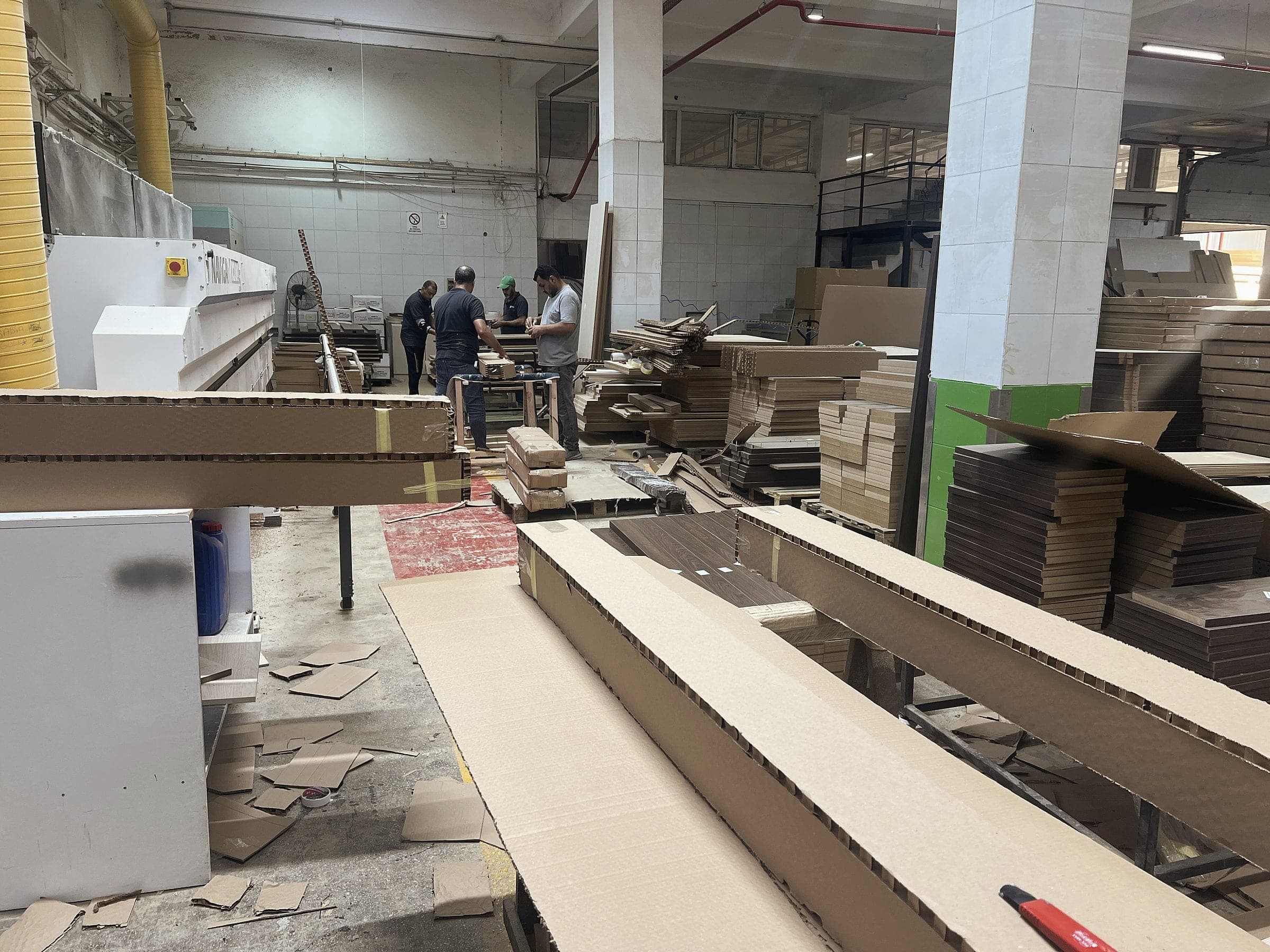
Photographs come with it, taken on the floor: the carcass on the assembly bench, the panel out of the spray booth, the bundle at the packing bench before it goes onto its pallet.
What happens on our side
The floor in Gemlik is 5,000 m² under our own production management. Machining, veneer, finishing and upholstery are in the same building, so a finish revision moves through one shop instead of five subcontractors, and its effect on the date is one number rather than five.
Packing and container loading happen at the factory, at the packing bench and the yard door. Nothing leaves the site between the saw and the container, which is the one part of the consolidation allowance we can actually act on: an order that is already a single consignment when it reaches the forwarder is not waiting on anybody else's cargo to fill a box.
Then the paperwork. Packing lists, the invoice, the proof of origin the destination needs and the loading photographs go out with the shipment rather than after somebody has to ask for them.
Who holds which part
The buyer holds the purchase order and the deposit. The design team holds the review rounds and the stamps, and publishes its own clock for them. The mill holds the fabric. We hold production, finishing, packing and the loading. The forwarder and the broker hold consolidation, the sailing and the entry. When a date comes under pressure, the useful sentence names which of those it sits with and what would move it, and that is the sentence we try to send before it has to be asked for.
How to read the transit figures
Both transit figures on this page are published sources you can check, and both have limits worth pricing in. The road table is a commercial haulier's, undated at source, and the Kapıkule queue moves the result by more than the table's own range. ONE's NTX sheet was last updated in April 2024, and carriers have been re-cutting the North Europe rotation in the time since. Neither goes into a programme without a live, dated number from the forwarder; the tables tell you what to ask him for.
Asked most
- What is your lead time?
- Quoted per package as a current estimate against the production plan, and reported when it moves. The offer fixes the scope, the price and the delivery date together. What this page adds is the other five segments of the clock, so the date in an offer can be read against the approvals and the transit rather than on its own.
- What does a published number of weeks actually cover?
- Because the figure a factory quotes covers the factory's own segment. Mitch Parker of Parker International: a vendor's lead time "does not consider the time needed for PO approval, shop, finish and cutting approvals, and delivery time." And Beyer Brown warns buyers that a quoted lead time "does not necessarily reserve production capacity." A figure that excludes four segments and reserves nothing is a figure that gets missed, and the missing is what buyers remember.
- How long does the design team's review take?
- The one published clock anybody can point at is the reviewer's own. The Beloit Procurement Services package specifies five working days per review round and five more for a resubmittal, with two rounds on a first submittal being ordinary. Those days belong to the design team. What a factory can do sits upstream of them: tag and transmit correctly so the sample enters the clock on the first attempt rather than the second.
- How long is shipping from Gemlik?
- By road, published haulier tables give 5 to 7 days door to door to Germany, the Netherlands and the UK, subject to the Kapıkule border queue. By sea, ONE's 2024 published NTX sheet gives 17 days to Felixstowe, 18 to Antwerp, 20 to Rotterdam and 23 to Hamburg. On top of either, arcedior's FF&E sourcing FAQ tells buyers to add 2-4 weeks for consolidation and customs clearance on cross-border projects from Türkiye and the countries it brackets with. We ask the forwarder for the live sailing before any of it goes into a programme.
- Does a quotation hold a slot in your production plan?
- By itself, no, and Beyer Brown is right to teach buyers to ask. What puts a package into the plan is a signed order and the deposit against it, and from that point the estimate is against a dated plan and the weekly reporting starts. Ask the question of every factory you are bidding; the answer should take one sentence.
Related
Working to a fixed opening date?
Send the specification or the guestroom drawing set with the date you have to hit. A net price comes back in writing, with the estimate against our production plan and the approval rounds listed beside it.