
Reference
Hotel joinery and millwork, and how it is actually graded
Hotel joinery and millwork is the fixed woodwork built into the building: wall panelling, wardrobes, vanities, headboard walls, reception desks and bar fronts. In the United States its quality is specified by grade under the Architectural Woodwork Standards, and the grades are measurable. A gap between two wood surfaces may reach 0.4 mm at Premium, 0.8 mm at Custom and 1.2 mm at Economy.
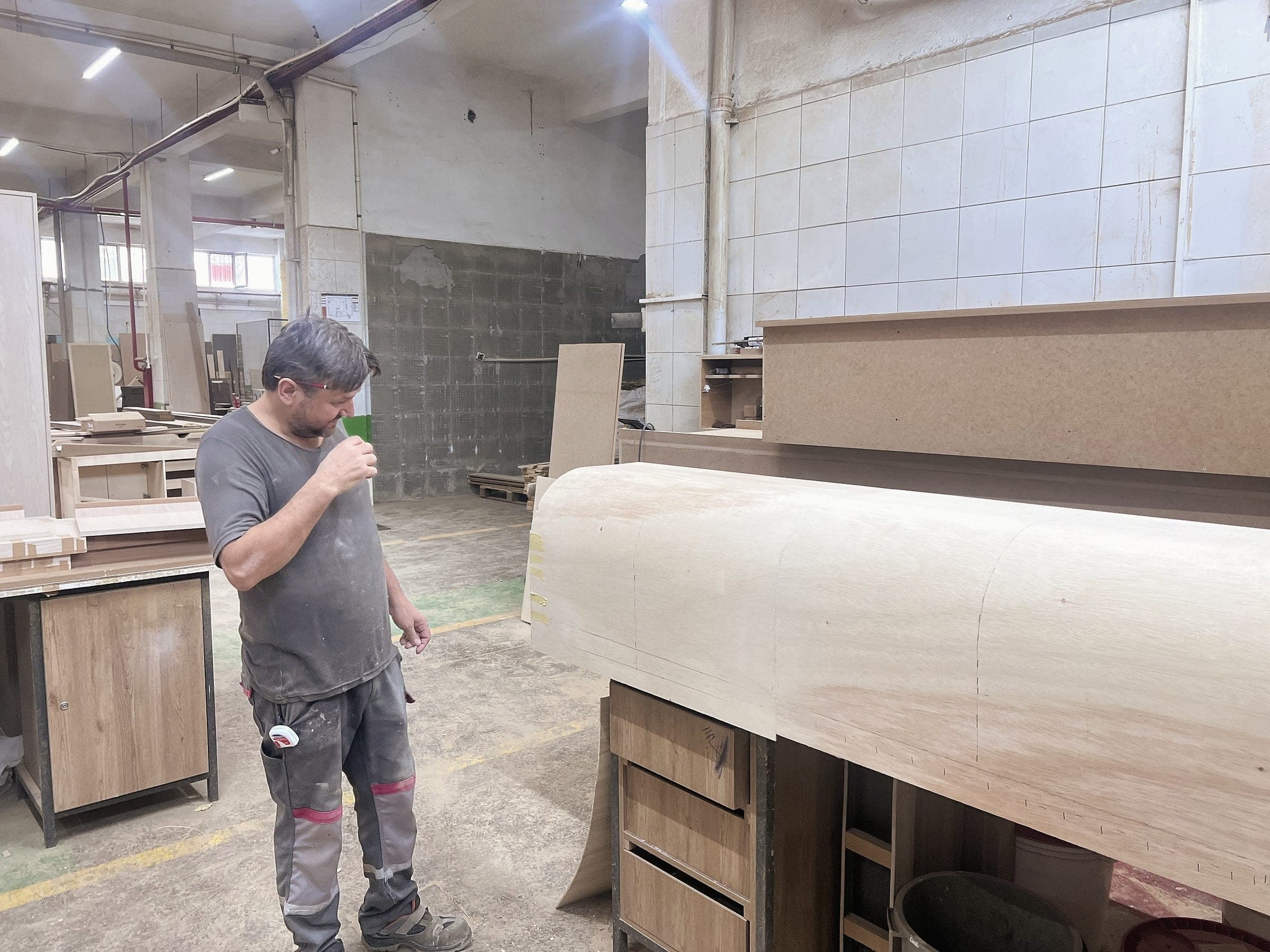
Millwork is the part of a hotel interior a guest touches without noticing: the wardrobe front, the panelled wall behind the bed, the vanity, the desk that runs into the joinery. Every firm selling it describes it in adjectives. The trade that specifies it uses numbers instead, and the numbers are published. This page is those numbers, and what they ask of a factory.
The AWI aesthetic grades, in millimetres
The Architectural Woodwork Institute publishes these tolerances in its own standards, section 3.4, Aesthetic. They are the clearest answer in the trade to the question of what separates one quality level from the next, because they can be measured with a feeler gauge on a finished piece.
| What is measured | Premium | Custom | Economy |
|---|---|---|---|
| Gaps, wood to wood, flat and shaped surfaces | 0.4 mm [.016"] | 0.8 mm [.031"] | 1.2 mm [.047"] |
| Gaps, wood to non-wood, flat and shaped surfaces | 0.8 mm [.031"] | 1.6 mm [.063"] | 2.4 mm [.094"] |
| Flushness, wood to wood, flat surfaces | 0.4 mm [.016"] | 0.8 mm [.031"] | 1.2 mm [.047"] |
| Flushness, wood to wood, shaped surfaces | 0.8 mm [.031"] | 1.2 mm [.047"] | 1.6 mm [.063"] |
| Flushness, wood to non-wood, flat and shaped | 0.8 mm [.031"] | 1.2 mm [.047"] | 1.6 mm [.063"] |
| Degree of control AWI attaches to the grade | Highest | High | Minimum |
What counts as joinery and millwork on a hotel job
The working line is whether the piece is fixed to the building. Wall panelling, wardrobes and their carcasses, headboard walls, bathroom vanities, minibar units, luggage benches built into a recess, reception desks, back-bar joinery, door architraves and skirtings are millwork. A bedside table you can lift is furniture. The distinction matters commercially, because fixed work is usually contracted through the fit-out package while loose furniture travels on the FF&E schedule, and the two are often bought by different people on the same project.
The other difference is dimensional. Loose furniture is made to a drawing; fixed joinery is made to a building, and buildings are not square. That is why site dimensions, and who takes them, belong in the contract rather than in a conversation. Our scope covers furniture and joinery manufactured in Gemlik; MEP, wet areas, flooring and stone are carried on the same contract and executed by trades we manage.
The grade is the specification, and it is a number
On a US or Gulf project written to American practice, a millwork specification names a grade from the Architectural Woodwork Standards: Premium, Custom or Economy. AWI describes them as levels of control, with Premium carrying the highest. What makes them useful is that the standard converts the description into tolerances. A gap between two wood surfaces may reach 0.4 mm at Premium, 0.8 mm at Custom and 1.2 mm at Economy. Where wood meets another material the allowance doubles: 0.8 mm, 1.6 mm and 2.4 mm.
AWI's Quality Certification Program puts the same difference in a way anyone can apply on a site walk. At Premium, a repair must be “virtually indistinguishable to the naked eye, even at a mere 24 inches”; at Custom, an imperfection visible within 48 inches is acceptable. The programme's own summary of the split is that “the main differences are aesthetic in regard to the materials and the tolerances for gaps and flushness of assembled joints and at installation”.
One rule inside the standard saves arguments later. AWI 300 – Materials, section 3.1(a): aesthetic grade rules “are used within AWI standards only in reference to the acceptable quality of workmanship, material, or installation in a completed Product and apply only to exposed and semi-exposed surfaces which remain visible after installation”. A grade is not a blanket applied to a project. It attaches to a finished product, on the faces that stay visible, which is why a specification that says only “AWI” without naming a grade and a scope item is a question rather than an instruction.
The European standard grades the timber, not the joint
A European specification is more likely to reach for BS EN 942:2007, Timber in joinery: General requirements. The NBS index describes its job precisely: it “gives details for grading and classification by appearance quality for timber used in joinery (products or parts)” and “looks at species, density, growth rings, surface quality, moisture content and remedial work”.
That is a different axis from the AWI grades, and the two do not convert into one another. EN 942 tells the mill which boards may be used on a visible face. AWI tells the shop how tight the joint between two of them has to be. A project can quite reasonably ask for both, and a package priced against one is not priced against the other.
The CEN standards catalogue records the classes as running from J2 to J50, graded on visible features: knots, grain slope, resin pockets, bark pockets, fissures, exposed pith, discoloured sapwood and beetle damage. Finger-, butt- and edge-jointing are permitted in classes J10 to J50. The class number is often explained on trade sites as a knot diameter in millimetres. That reading is not in the catalogue abstract, so it is left out here.
The panel behind the veneer has its own rulebook, and it changes by destination
Most hotel millwork is a wood-based panel with a veneer, laminate or lacquer face, and the panel is regulated in its own right. For work entering the United States, the EPA's rule under TSCA Title VI covers hardwood plywood, medium-density fibreboard and particleboard “sold, supplied, offered for sale, imported to, or manufactured in the United States”, with provisions for laminated products, product testing, labelling, recordkeeping and import certification. Since 22 March 2019 the product has to be labelled as TSCA Title VI compliant.
In Europe the relevant handle is the formaldehyde class under EN 13986. Class E1 covers panels whose formaldehyde release does not exceed 0.124 mg/m³, equivalent to 0.1 ppm, tested to EN 717-1. That figure is published consistently by testing laboratories and panel manufacturers, though the standard itself sits behind a paywall.
Name the standard your destination needs in the specification and the build-up is specified to meet it, with the test evidence issued against that build-up. A panel choice made at drawing stage is cheap; the same choice made at customs is not.
What to ask a joinery shop, and what a good answer sounds like
Which grade the quotation is priced to, per scope item rather than for the job. Which standard governs the timber on visible faces, and at what moisture content the piece will be delivered. What the substrate is, in millimetres, and which panel-emission class it carries for the destination. How veneer is matched across a run of doors, and whether the match holds from room to room or only within one piece.
Then the two that decide the install: who takes the site dimensions for fixed work, and whether the piece is built as one unit or knocked down for the lift. A shop that answers all six without going away to check has built the scope before. A shop that answers them in adjectives has not.
How joinery is made here
Joinery is about half of what leaves the Gemlik floor. The timber shop and the solid-frame work sit on the top floor with the fabric and foam store; machining, the veneer press, the spray booth, stores and packing are below, in the same building, so a finish revision moves through one shop instead of five subcontractors. We work from your drawing set and our drawing office issues shop drawings against it. Where a specification names a grade or a standard, the build-up is specified to meet it and the evidence is issued against that build-up. Our work is installed in Mövenpick Istanbul, DoubleTree by Hilton Jeddah and Marriott Belgrade, where the package ran to roughly 1,500 pieces.
Where these numbers come from
The tolerance table is AWI's own, from section 3.4 of its standards, and the 24-inch and 48-inch inspection rule is published by AWI's Quality Certification Program. The section 3.1(a) wording is quoted verbatim from AWI 300 – Materials. The EN 942 description is the NBS publication index's abstract, and the class list comes from the CEN standards catalogue rather than from the standard itself, which is why the knot-diameter reading is left out. The TSCA Title VI scope and labelling date are the EPA's. All of it is readable without paying for a standard.
Questions we get asked
- What is the difference between joinery and millwork?
- Mostly geography. Millwork is the North American word and joinery the British and Commonwealth one, and both mean woodwork made to a project's own drawings rather than bought from a catalogue. On a hotel job either word covers the fixed woodwork: wall panelling, wardrobes, vanities, headboard walls, reception desks, bar fronts, architraves and skirtings.
- What does AWI Custom grade actually mean?
- It is a set of measurable tolerances, not a description. Under the Architectural Woodwork Standards a Custom-grade gap between two wood surfaces may reach 0.8 mm, against 0.4 mm at Premium and 1.2 mm at Economy. Where wood meets another material Custom allows 1.6 mm. AWI's Quality Certification Program adds the site test: at Custom an imperfection visible within 48 inches is acceptable, where Premium requires a repair to be indistinguishable at 24 inches.
- Does an AWI grade apply to the whole project?
- No. AWI 300 – Materials, section 3.1(a) states that the grade rules apply “only to exposed and semi-exposed surfaces which remain visible after installation”, and they attach to a completed product. A specification therefore names a grade per scope item, and one hotel can carry different grades in the suites, the general guestrooms and the back of house.
- Which standard covers joinery timber in Europe?
- BS EN 942:2007, Timber in joinery: General requirements. The NBS index describes it as giving “details for grading and classification by appearance quality for timber used in joinery”, covering species, density, growth rings, surface quality, moisture content and remedial work. It grades the board rather than the joint, so it answers a different question from the AWI grades and a project may specify both.
- What panel compliance does hotel millwork need?
- It depends on where it is going. Composite wood products sold, supplied, offered for sale, imported to or manufactured in the United States fall under the EPA's TSCA Title VI rule and have to be labelled as compliant. In Europe the usual handle is the formaldehyde class under EN 13986, where class E1 covers panels releasing no more than 0.124 mg/m³, or 0.1 ppm, tested to EN 717-1. Name the one your destination needs and the build-up is specified to meet it.
- Do you make joinery as well as furniture?
- Yes, and joinery is about half of what the Gemlik floor produces. Timber, machining, veneer pressing, spraying and packing all happen in the same building, which is what lets a finish change move through one shop rather than through five subcontractors.
- Who measures the site for fixed joinery?
- It should be written into the contract before anything is cut, because fixed work is made to a building rather than to a drawing. On a real US procurement package field measurements for custom items are the fabricator's responsibility. Whoever carries it, the risk that the shell is out of true is a real line item and belongs with a named party.
Related
Send the millwork drawings. Get a net price back.
Name the grade and the destination and the quotation will price the build-up against them. We reply within 24 working hours, in English, Arabic or Turkish.
Send the BOQ. Get a factory-direct number