
Reference
Who actually owns the factory
A company selling hotel furniture is usually one of three things: a manufacturer running its own plant, a manufacturer-by-partner overseeing production in plants that belong to its partners, or a trader reselling finished goods. The word "manufacturer" is used by all three. In Türkiye, documents settle it: exporters'-association membership is compulsory under Law 5910, customs validates the association's approval code before goods leave, and TOBB's rules bar issuing a capacity report to a firm that subcontracts its production out.
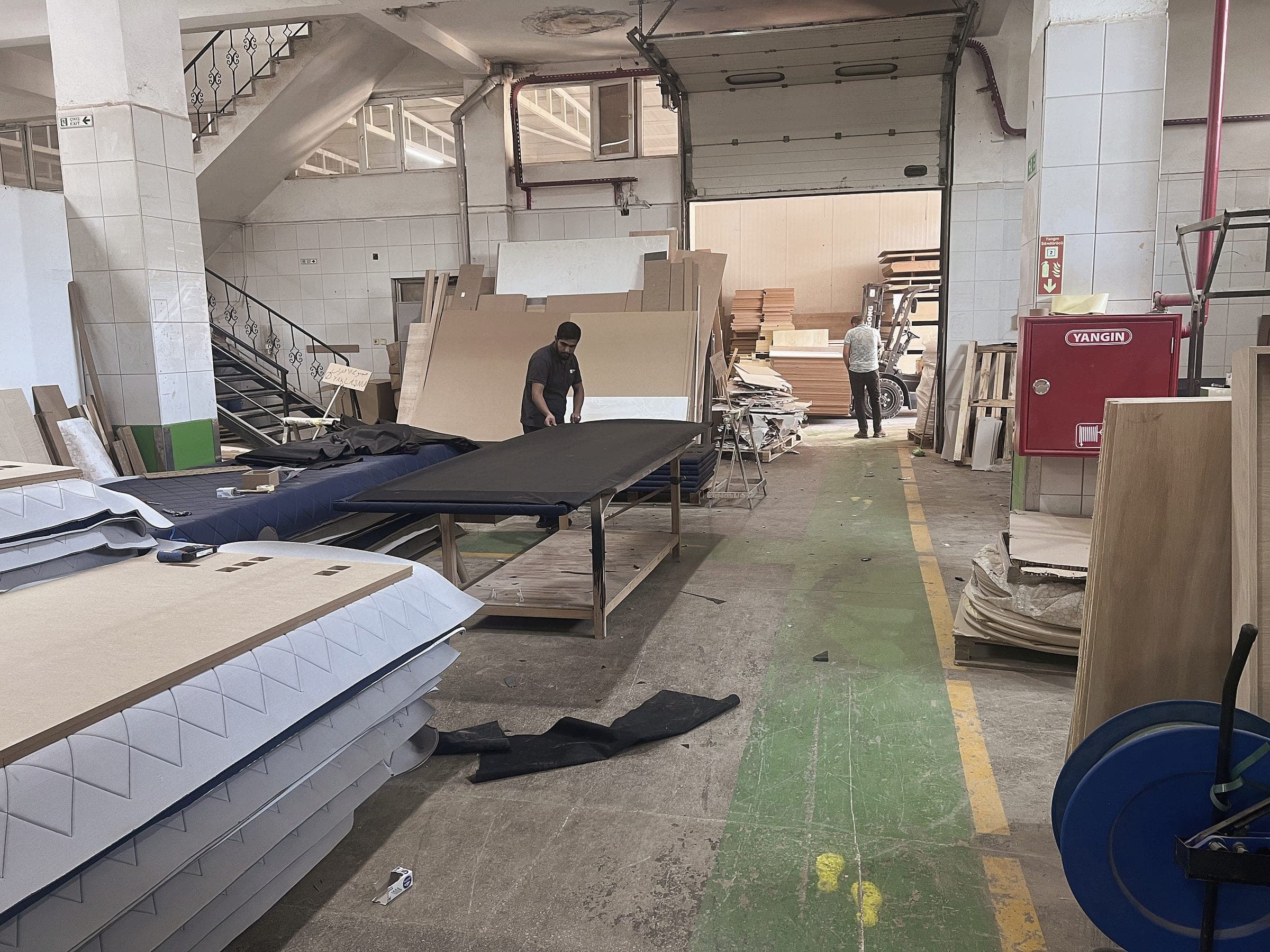
Three shortlisted suppliers can all call themselves manufacturers and all mean something different by it. One runs the plant it names. One designs, engineers and quality-controls in plants that belong to its partners. One buys finished goods and resells them. Each is a legitimate way to sell furniture, and each answers differently when a schedule slips or a finish drifts, because the distance between the person you call and the person at the spray booth is different in each. The word on the website does not carry that distinction. The paperwork does, and in Türkiye two of the decisive records are free to check from a desk. This page names the three models, quotes two firms that state theirs plainly, and lists the checks a buyer can run before sending a BOQ.
The three models
Read the accountability column first. The models differ less in what they promise than in who has to keep the promise, and the last column is the part you can check without asking anyone's sales team.
| Model | What one contract gets you | Who keeps the promise | Where each serves you well | What the documents show |
|---|---|---|---|---|
| Manufacturer | Capacity the seller itself controls; a finish revision is an instruction to its own floor | The company you pay runs the machines and employs the people who make your goods | Custom programmes at volume; revisions mid-production; anything where the making is the risk | In Türkiye: an exporters'-association record against its own tax number, a production address it operates, and a chamber-issued, TOBB-approved capacity report |
| Manufacturer-by-partner | Design, engineering, QA and one commercial contact; production runs in partner plants | The seller answers commercially; the making sits with factories it oversees rather than owns | Multi-category packages no single plant makes; oversight on the ground where you cannot be; origin flexibility when duties move | Its own wording, read closely: "manufacturing partners", "partner facilities", oversight teams. The plant addresses belong to other companies |
| Trader / dealer | A catalogue and a price; goods made by whichever factory the trader buys from | The seller passes your claim to its source; leverage depends on its buying power | Stock programmes, small lots, fast availability, spares and reorders | No production address of its own, and the exporter of record on the customs declaration is frequently another company |
Two firms that state their model plainly
The middle model is real, and the clearest descriptions of it come from firms that practise it. BermanFalk, a Canadian hospitality furniture house, writes on its own About page: "While we utilize trusted global manufacturing partners, our own on-the-ground teams directly oversee every stage of production in Asia." WTB Company, a Turkish contract-furniture firm, states on its homepage: "Through our manufacturing partners in Türkiye, including large-scale facilities exceeding 35,000 m², WTBCompany supports high-volume production." Both wordings were read on 29 August 2026, and both do the buyer a service: the model is named, and the diligence questions that follow are obvious ones: which plants, whose quality system, who answers when something drifts.
The harder case is the site that runs manufacturing language and partner language in adjacent sentences without saying which model is quoting you. That is a wording, and the checks further down this page do not care about wording.
The purchasing agent is a fourth seat, and it sells nothing
One class of company belongs outside the table. A fiduciary purchasing agent buys on the owner's behalf for a disclosed fee and holds no goods to sell, so the three models above do not apply to it; your diligence belongs on the factories it puts on the bid list. The agent, the dealer and the factory-direct route are compared in the firms' own words on a page of its own on this site, linked below. This page is about the sellers.
What can "30 years of manufacturing experience" mean?
Read as a claim, the phrase can carry at least five different facts: the years of the current legal entity; the years of a predecessor company; the founders' years in the trade before the entity existed; the staff's years added together; or years spent buying and managing furniture production rather than running it. All five produce true sentences. WTB's homepage says "Nearly 25 Years of Combined Hospitality Furniture Expertise" — and the word combined is the honest form, because it tells you how the years were counted. BermanFalk's "over 30 years of manufacturing experience" sits one page from its partner disclosure, and reading the two sentences together is exactly what its About page lets a careful buyer do.
The test costs one question: which entity do the years belong to? Then ask the registration date separately, because that one is a registry fact rather than a marketing fact.
We state our own history as three separate facts because they are three separate facts. Naggarco Group's Turkish LLC was registered on 11 February 2025. The team behind it has manufactured furniture in Türkiye for about five years. And the El-Naggar family's carpentry trade in Egypt is older than either: the name means carpenter. None of the three is asked to stand in for the others.
In Türkiye, membership is the law and the export record is public
Türkiye regulates who may export. Law 5910 of 2009 makes membership of the relevant exporters' association compulsory for exporters (art. 4: "İhracatçıların ilgili birliğe üye olmaları… zorunludur"), and the Export Regulation's art. 17 puts the mechanism at the customs gate: automated customs offices look for the association's electronically generated approval code on the export declaration, and goods are not released against a declaration whose code does not validate.
The practical consequence is a free classifier. A company that exports Turkish-made furniture in its own name has an association record, and TİM, the Turkish Exporters' Assembly, publishes a lookup that takes a tax number, needs no account, and returns the registered company name, the exporters' union and the member registration number, with a button that generates a membership certificate. Ours: tax number 6271644768 returns İstanbul Mobilya, Kağıt ve Orman Ürünleri İhracatçıları Birliği (the Istanbul furniture, paper and forest-products exporters' union), member 50536.
A supplier with no record is not necessarily making nothing. It means the goods leave Türkiye in another company's name, a partner's or a trading house's, and that is precisely the fact this page is teaching you to establish before it matters.
What the Turkish capacity report proves
Capacity is the question buyers most want a number for, and Türkiye answers it with a document rather than an adjective. The Kapasite Raporu is issued by a manufacturer's local chamber and approved by TOBB, carries a QR code, and its figure is derived from a physical inspection of the machine park by a named engineer, calculated at eight hours a day over three hundred days a year, which is one shift. It is valid for at most two years, it states a theoretical maximum rather than a promised throughput, and TOBB's rules bar issuing one to a firm that has its production done on a toll basis: the preconditions include machinery installed and running at the moment of inspection and production staff on the payroll. The document exists only where a production operation exists, which is what makes it worth asking a Turkish supplier for at all.
Our own answer to the capacity question is the floor in Gemlik: come and walk the stations in the order the material moves, and bring the piece list you want made.
The checks, in the order a buyer would run them
- Ask for the registered legal name, the trade-registry number and the tax number, in writing. A Turkish company has all three and loses nothing by writing them down. The MERSİS number belongs on its commercial correspondence; the public registry behind it is login-only, so the working checks are the next four.
- Put the tax number through TİM's membership lookup. Free, no account. What returns is the registered name, the union and the member number; what it settles is in whose name goods leave Türkiye.
- Ask which company operates the production site, and for the site's address in writing. "Our partner's plant in İnegöl" is a legitimate answer that tells you the model. The address should still arrive in writing.
- Take a live video walk-through. Raw-material store, machining, veneer and press, spray, upholstery, packing — in the order the material moves. Any seller can arrange one; what you learn is who has to arrange it for them, and whether the people on camera work for the company you are paying.
- Put the model room before the volume release. One room built against your specification, reviewed at production quality, is evidence about the making itself, and it is the stage where a partner-made or resold package has to show its real source.
- Check the chamber record. Turkish chambers publish their member registers through TOBB's national database, searchable free by company name per chamber.
When manufacturer-by-partner serves you well
The model earns its place on real projects. No single plant anywhere makes casegoods, seating, drapery, stone and lighting equally well, and a partner network can hold one purchase order across categories that would otherwise mean five vendors. Oversight teams based near the plants watch production a buyer cannot visit. And when duties move, a partner network can move origin faster than any single factory can. What makes the model work for a buyer is disclosure: you know which plant is making your package, whose quality system it runs under, and who answers when something drifts. Established at the shortlist, that is a business model. Established at the punch list, it is a surprise.
Our own answers, as a specimen
Any supplier on your shortlist can be asked for the list above, so this page ends with a specimen rather than advice. Naggarco Group manufactures hotel interiors in Gemlik, Bursa: a 5,000 m² production floor with our own machining, veneer, finishing and upholstery in one building, a 350 m² showroom on the same site, and 8 model rooms, built, shown and rebuilt against live specifications. MERSİS 0627164476800001, trade registry 6993 (Gemlik), tax number 6271644768. Entered in TİM's lookup, that tax number returns union membership 50536, as above. Delivered work is published project by project: Mövenpick Istanbul, DoubleTree by Hilton Jeddah, Hilton Garden Inn Jeddah, Marriott Belgrade at about 1,500 pieces, Rotana in Georgia, Citadines by Ascott — each with a page, a city and a scope. A video walk-through can be arranged on request; the visit is better.
Asked most often
- Is a manufacturer-by-partner a worse supplier than a manufacturer?
- No. It is a different allocation of the same responsibilities, and on multi-category packages it can be the stronger one: one purchase order across casegoods, seating, soft goods and lighting, with oversight teams near plants you cannot visit. What a buyer should establish is which plant makes each category, whose quality system it runs under, and who answers commercially when something drifts. A firm that states the model plainly, as BermanFalk and WTB do on their own sites, has already answered the first question.
- What is the fastest free check on a Turkish furniture supplier?
- The tax number through TİM's membership lookup. It needs no account and returns the registered company name, the exporters' union and the member registration number, with a certificate button. Turkish law makes association membership compulsory for exporters (Law 5910, art. 4), and customs validates the association's approval code before export goods are released (Export Regulation, art. 17), so the record tells you in whose name goods actually leave Türkiye. Ours: 6271644768 returns the Istanbul furniture exporters' union, member 50536.
- What does "manufacturer and exporter" on a website prove?
- By itself, nothing: all three models use the phrase. Each half is checkable separately. The exporter half, in Türkiye, is the association record above. The manufacturer half is a production address the company itself operates, a live walk-through of it, and a model room built against your specification before volume release.
- Can a trading company hold a Turkish capacity report?
- TOBB's rules bar issuing a Kapasite Raporu to a firm that has its production done on a toll basis, and the preconditions include machinery installed and running at inspection and production employees on the payroll. The report is chamber-issued, TOBB-approved and QR-verifiable, and its figure is a theoretical single-shift maximum — a risk-column document, never a promised throughput.
Related
Running this test on a shortlist?
Send the specification or the guest-room drawing set and a net price comes back in writing. Or come to Gemlik and walk the production floor in a working day; the showroom is on the same site.