
Comparison
Türkiye, Portugal or Italy
When Asia comes off a hotel project, the shortlist that replaces it is Italy, Portugal and Türkiye — and price is not what separates them. Duty into the EU is level: Turkish hotel furniture enters duty-free on an A.TR inside the Customs Union, so Portugal and Italy hold no duty advantage. What actually decides it: capacity in your window, how much of the room lands on one contract, proximity to the model room, and one customs step that is ours to carry.
When Asia comes off a project, the list that replaces it is short. The trade reporting through the 2025 tariff round names Italy, Portugal and Türkiye in the same breath, and Canoe Hospitality's published sourcing map puts our half of it plainly: "Meanwhile, Turkey is gaining traction beyond textiles, emerging as a player in casegoods and seating production" (Shawn Fowler, 16 April 2025). This page compares the two halves of that list. We are the Turkish half, and every row below ends with a way to check it that does not depend on either side. Price is not the axis and no cost comparison appears here. What actually separates the two is capacity, how much of the room sits on one contract, and what happens at the border.
The six rows that decide it
Two of these rows are level between the three countries. Read the last column: each row ends with the document or the step that settles it.
| The question | Portugal or Italy | Türkiye, and us specifically | How to check it |
|---|---|---|---|
| Duty into an EU member state | Zero. They are inside the internal market and there is no border to clear | Zero. Hotel furniture is industrial goods and moves inside the EU–Türkiye Customs Union on an A.TR movement certificate, whatever the board and the hardware cost | Ask each bidder which document proves it. Ours is an A.TR raised per consignment, approved by the chamber in Gemlik and vized electronically by Turkish customs |
| Proof of non-Chinese origin | Answered by the EU origin of the goods themselves | A different document from the A.TR. An A.TR proves free circulation, not origin; a certificate of origin answers the origin question and we raise one on request | If a content rule, a trade-defence exposure or your own onward re-export needs origin, write origin into the RFQ. A supplier who answers with an A.TR has answered something else |
| Capacity outside Asia | Real, and long established in both countries | A 5,000 m² production floor in Gemlik, Bursa, under our own production management, with machining, veneer, finishing and upholstery in one building | Ask every bidder for its chamber-issued capacity report and read whose name is on it before you read the number. The factory-or-trading-company test has a page of its own |
| How much of the room lands on one contract | Usually the manufactured lines. Ask where responsibility for the rest sits | Furniture and architectural joinery from our own production; soft furnishings, lighting, flooring, wet areas and interior MEP carried on the same contract by subcontractors under our management. The boundary is the shell | Put both answers on the responsibilities matrix before the bid rather than after it, and read the boundaries against each other |
| Getting to the model room | A short flight or a drive for a European buyer. For a US buyer, a long trip either way | Gemlik is thirty minutes from the port and about ninety minutes from Istanbul. The showroom on the same site is 350 m² and holds 8 model rooms, built and rebuilt against live specifications | Book both visits and compare the time and the cost. On a US project this row favours neither of us against a domestic bench |
| The customs step, and what it adds | None inside the EU | One consolidation and clearance step, and it is ours to carry. The FF&E sourcing firm arcedior tells buyers to "add 2-4 weeks for consolidation and customs clearance" on cross-border projects from Türkiye | Ask for it as a named line on the programme rather than as a caveat in a covering letter |
The slot this page is competing for
Search the published commentary from the independent purchasing firms and the geographies named out loud are China, Vietnam, Asia broadly, domestic North American production, and then a short list of alternatives running Italy, Portugal, Türkiye, Colombia, Indonesia and Mexico. That list is where this comparison lives. The question in the room is rarely Türkiye against China; it is which of the non-Asian options gets the second slot.
Two published sentences set the frame. On why Europe re-entered the conversation at all, Alan Benjamin of Benjamin West: "a lot more people asking about sourcing in Europe", particularly for "luxury, bespoke, and high-design hotels", where "when the euro was trading around $1.20, it didn't make sense". On whether we are in the frame at all, Shawn Fowler of Canoe Hospitality in April 2025: "Meanwhile, Turkey is gaining traction beyond textiles, emerging as a player in casegoods and seating production."
And the doubt every non-Asian supplier has to answer, from Nicole Schmidt of Source: "large-scale shifts in production regions are unlikely due to capacity limitations outside of Asia". Read as written, that is not a claim that Portugal, Italy or Türkiye cannot make furniture. It is a claim about how much of a global book any of them can absorb, which makes the useful question at the bid table narrower than a country: which building has the machine hours free in the window you need, and who signs the finish off.
Duty into the EU, where neither side has an advantage
This row is usually assumed to be the one a Turkish supplier loses, so it is worth settling first. Hotel furniture is industrial goods, and industrial goods move between Türkiye and the EU inside the EU–Türkiye Customs Union. The instrument is an A.TR movement certificate, raised per consignment, approved by the chamber in Gemlik and vized electronically by Turkish customs, and goods travelling on it enter any member state duty-free. Component origin does not change that: Austrian hinges, German board and an Italian laminate front make no difference to the rate.
So a Portuguese or an Italian factory holds no duty advantage into the EU, and neither do we. The row is level, and anyone arguing this comparison on European duty is arguing a row that does not exist. What is not level is the paperwork step behind the certificate, and it is further down this page with the number a named source puts on it.
There is also a trap here, and it is better raised by us than found by your broker. An A.TR proves free circulation, not origin. It does not satisfy a content rule in a public procurement, a trade-defence exposure, or your own onward re-export, and that is a separate non-preferential question answered by a certificate of origin. It is increasingly what a sophisticated European buyer means when he asks where something is from, so ask for origin by name when origin is what you need. A broker asking us for a EUR.1 for Germany is asking for the wrong document: EUR.1 is for our FTA partners outside the Customs Union.
Capacity, and how much of the room lands on one contract
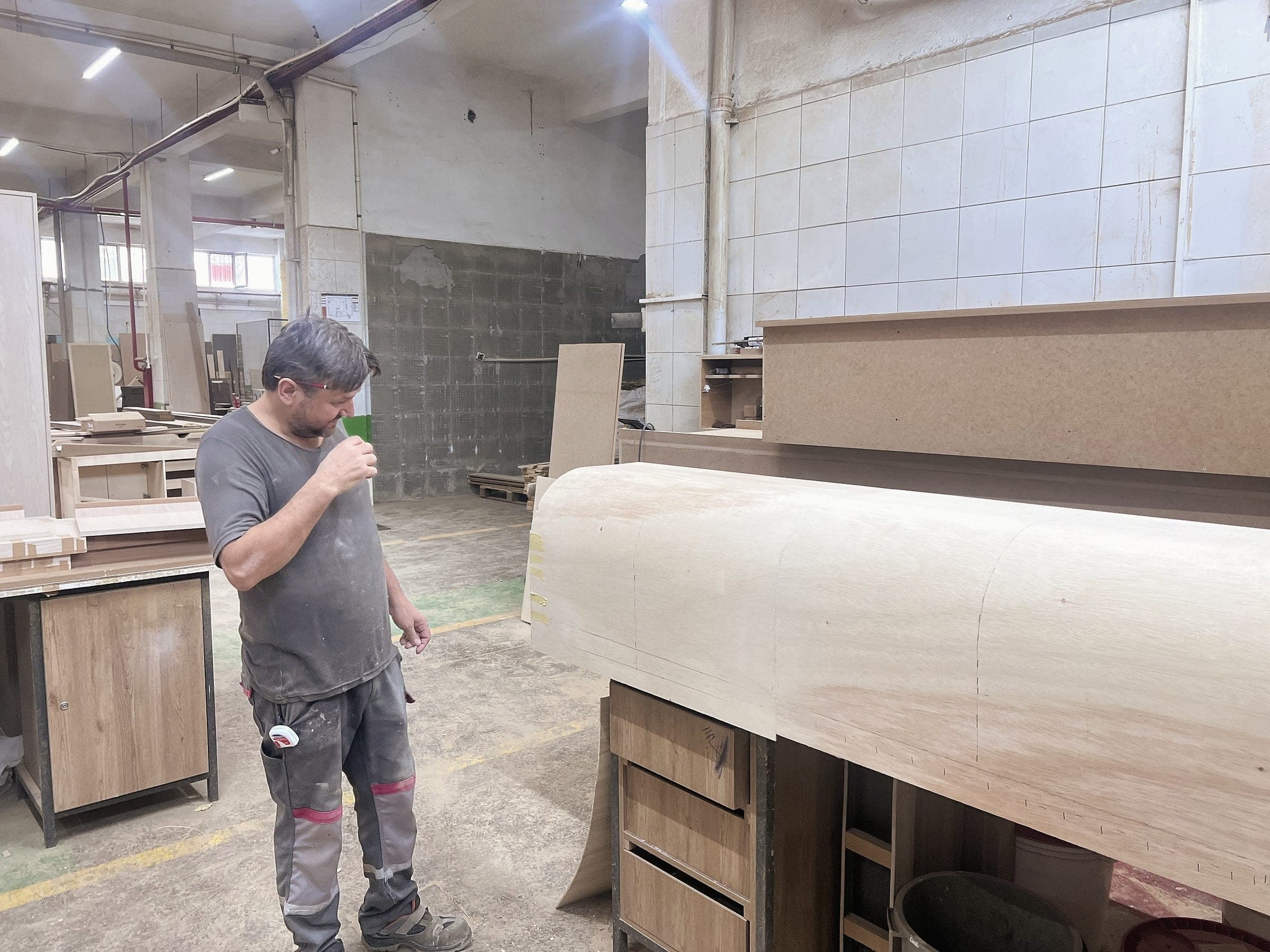
5,000 m² of production floor in Gemlik, Bursa, under our own production management. Board arrives at the yard door and goes to the sliding table saw. Carcass parts are machined on the CNC router, drilled on the boring machine and assembled one unit at a time. Veneer, lacquer and paint go on in our own spray booths, and frames, foam and fabric are cut, sewn and fitted in the upholstery bay. Packing and container loading happen on the same site. Architectural joinery runs through the same shops: wall panelling, door sets, reception desks, wardrobes, worktops, decorative ceilings and stairs.
The scope on one contract is wider than the manufactured lines, and this is the row where the comparison is most often mis-stated. Furniture and joinery are manufactured by us. Soft furnishings, lighting, flooring, wet areas and interior MEP are carried on the same contract and executed by subcontractors under our management. The boundary is the shell: structure and civil works are out, OS&E is out, everything inside is in. Put that sentence beside each bidder's own and read the boundaries against each other, because a package split across a casegoods factory, an upholstery house, a lighting supplier and a fit-out contractor is four boundaries instead of one.
One delivered programme carries a quantity: Marriott Belgrade, approximately 1,500 pieces, two custom guestroom types and the restaurant, delivered to Belgrade by road. It is the only piece count on this site, and it carries one because there is a published record behind it. Accor, Hilton, Marriott, Rotana, Ascott and IHG standards have each governed a scope we manufactured to.
Proximity, the border and the names
Proximity, first. For a European buyer a Portuguese or an Italian factory is a short flight and a day trip, and Shawn Fowler's sourcing map states the case for the near factory plainly: "Designers, owners, and operators benefit from the ability to visit production facilities during the prototyping phase, enabling nuanced refinements that are harder to achieve remotely." The mechanism is the visit during prototyping, so put the visit on the programme whoever bids: ours is booked against the model room, ninety minutes from Istanbul's airports and a day trip from most of Europe.
The border step, second. An Italian or a Portuguese consignment into another member state clears no customs at all; a Turkish consignment clears one, and arcedior, an FF&E sourcing firm, tells buyers to "add 2-4 weeks for consolidation and customs clearance" on cross-border projects from Türkiye. Ask for the step as a named line on the programme at contract, with the A.TR raised per consignment: a customs step that is planned is a line item, not a risk.
The names, third. This market's published commentary names Italy and Portugal without gloss; Türkiye arrives with Fowler's April 2025 sentence attached, which is why it is quoted at the top. A drawing that wants a named Italian house for what the name does in a design review is specifying the name. A bill of quantities that wants the room manufactured, carried and installed on one contract is specifying the work, and that is the document this page is written for.
Portugal and Italy, in their own published numbers
Italy is the giant of this comparison, and its numbers are published every April. FederlegnoArredo's study centre put the Italian wood-furnishing chain at €52.2 billion of production revenue for 2025, across more than 62,000 companies and 292,000 employees, with the furniture macrosystem itself at €27.7 billion and €14.2 billion of that exported; France, the United States and Germany are the three largest markets (economic note for the 64th Salone del Mobile, 8 April 2026). The design machine behind those numbers is real. Salone del Mobile 2025 counted 302,786 attendees from 160 countries on its own annual report of 19 December 2025, the fair has announced a dedicated Salone Contract for 2027 aimed at hospitality, and the Brianza district alone held 1,627 wood-furniture companies with 11,934 employees at the mid-2025 count (Centro Studi FederlegnoArredo, via Regione Lombardia, 25 June 2025).
Portugal is smaller and export-led, and its association publishes too. AIMMP reported €2.96 billion of wood and furniture exports for 2025, with Spain taking 35% and France 25% (reported by ECO, 11 March 2026); Eurostat's business statistics for 2024 count 4,545 Portuguese furniture manufacturers employing 36,850 people. The industry concentrates in the north around Paços de Ferreira, whose Capital do Móvel fair dates from 1984, and the cluster's industrial depth shows in a checkable place: IKEA's factory there is the fifth largest of the group's thirty-one worldwide (ECO, 15 November 2025). AIMMP's push into hospitality began in 2022 and runs by name: a fourteen-company delegation at Boutique Design New York in 2023, a stand at HD Expo Las Vegas in 2025.
Read together: Italy's furniture industry is roughly ten times Portugal's by turnover (Eurostat, 2024: €26.6 billion against €2.66 billion), and in CSIL's June 2025 survey of European contract furniture, a market it puts above €13.5 billion with hospitality the second-largest segment, Italy is named among the top five producing countries and Portugal is not named at all. Both halves of that sentence are worth having on one page, and both come from the associations' own publications.
The Türkiye column of this page is one factory's account of itself, not an association's account of an industry: the checkable facts here are the floor, the A.TR and the delivered programmes, and the industry-level sentence on the Turkish bench stays Fowler's, quoted at the top. And note what none of these published numbers answer, for any of the three countries: a price and a lead time. The associations count factories and turnover; what your bill of quantities costs and how long your program takes are answered per specification, in writing, by whoever bids it.
The United States, and the second country of origin
On a US project the geography is plain: Türkiye is further from an American site than a domestic bench or Mexico, and the prototyping visit Fowler describes is a transatlantic flight rather than a domestic one. That sets the shape of the ask.
So the ask on a US project is not the package. It is the second country of origin. Benjamin West publishes the recommendation, in a piece co-authored by Alan Benjamin and Sarah Churchill: "When the client directs the project team to have items in the model room sourced from a minimum of two vendors per specification/commodity, and ideally from two countries of origin, it allows for multiple options and the ability to pivot as needed." Read it inside its own frame. It is one firm's published recommendation and it is conditional on the client directing it, not a market default. But it describes the slot precisely, and the decision it describes sits at the model room rather than at the production bid, which is a far cheaper yes than a package.
Duty is the other half of a US answer, and it is a per-line question rather than a country question. The rate turns on the HTS classification of the specific item, which is your broker's answer to give and not ours to generalise. The United States page sets out what we know about the lines we ship, and the Türkiye-or-China comparison covers the Asian side of the same decision.
Transit, in published numbers
No index covers Türkiye origins, so this page quotes carriers and forwarders by name instead of a market rate. By sea, Ocean Network Express's published NTX direct transit from Gemlik is 17 days to Felixstowe, 18 to Antwerp, 20 to Rotterdam and 23 to Hamburg, on its 2024 service sheet. That is one specific slow loop with Gemlik at the far end of it; a transhipment routing via Piraeus or Malta can be faster, so take the live number from a forwarder.
By road, the published tables from Turkish forwarders put Germany, the Netherlands and the UK at 5 to 7 days from the Marmara region, Belgrade at 2 to 4 days, and Zagreb or Ljubljana at 3 to 4, all of them subject to the queue at Kapıkule, which is the single biggest variance on the lane. Those tables are the forwarders' own, undated, and silent on whether destination clearance sits inside the count, so treat them as bands. An EU-to-EU truck over a comparable distance crosses no border at all; that is the same border step priced in the section above.
One live change is worth having if a quotation names Hamburg. Maersk's SLC Aegean Sea rotation drops Hamburg from week 36 of 2026 and calls Wilhelmshaven instead, first call 6 September 2026, per Maersk's own service notice. Any Gemlik quotation still naming Hamburg as the Maersk discharge port is out of date from September, ours included if we ever write one.
Price and quality, and where they live
Price on this comparison lives on your bill of quantities, priced by each bidder from the same specification, so no page-level cost figure appears here. Quality is the written specification: the board, the foam density, the fabric, the hardware, and the fire and strength standards named in the contract. Ask every bidder to price the same specification and compare it line by line, because the supplier who will not write it down has answered you.
How to check every row
Every fact on this page about Portugal and Italy carries a named public source, and the fastest rows to verify never touch either side's marketing: the carrier's transit sheet, the sourcing firm's customs instruction, the associations' own annual notes. Our side closes the same way: the A.TR raised per consignment, the chamber-issued capacity report, and a working day in the building at Gemlik, with the showroom and the floor on one site.
Asked most
- Is Türkiye cheaper than Portugal or Italy?
- Usually, yes. On a like-for-like specification our quotes come in below Portuguese and Italian bids: the cost base in Türkiye is lower, and A.TR means the EU border adds no duty to close the gap. The number that decides it is still yours — send the specification or the guestroom drawing set and a net price comes back in writing, line by line, so it can sit next to the other bids on paper.
- Do we pay duty on furniture coming from Türkiye into the EU?
- No. Hotel furniture is industrial goods and moves inside the EU–Türkiye Customs Union on an A.TR movement certificate, entering any member state duty-free, whatever the origin of the board and the hardware. A Portuguese or Italian supplier holds no duty advantage over that. Ask for the A.TR by name and check it is raised per consignment.
- Does an A.TR prove the furniture is not Chinese?
- No, and it is the question worth asking early. An A.TR proves free circulation, not origin. Where a content rule, a trade-defence exposure or an onward re-export needs origin, the document is a certificate of origin, which is separate and which we raise on request. Asking a supplier for an A.TR when you meant origin is the most common way this goes wrong.
- How much does the border step add against a European supplier?
- arcedior, an FF&E sourcing firm, tells buyers to "add 2-4 weeks for consolidation and customs clearance" on cross-border projects from Türkiye. An intra-EU movement has no equivalent step. Ask for it as a named line on the programme at contract, alongside the A.TR raised per consignment: planned, it is a line item rather than a risk.
- We are building in the United States. Why look at Türkiye at all?
- For the second slot rather than the first: a domestic bench is closer, and the slot that fits us is a different one. Benjamin West publishes the recommendation that when a client directs it, model-room items should be sourced from at least two vendors per specification and ideally from two countries of origin. That is the slot we are asking for, it is decided at the model room, and it is a much cheaper yes than the whole package.
- How big are the Portuguese and Italian furniture industries?
- Italy's wood-furnishing chain closed 2025 at €52.2 billion of production across more than 62,000 companies, per FederlegnoArredo's April 2026 economic note. Portugal exported €2.96 billion of wood and furniture in 2025 per AIMMP, with 4,545 furniture manufacturers in Eurostat's 2024 count. Both associations publish annually; neither publishes hotel-program prices or lead times, and neither do we.
Related
Comparing us against a European bench?
Send the specification or the guestroom drawing set and a net price comes back in writing, line by line, so it sits next to the other quotations. Or come to Gemlik and walk the floor on a working day; the showroom and the model rooms are on the same site.