
Reference
The model room, and the samples that come before it
One room decides the rest: a hotel guestroom package is released to production only after the designer reviews the drawings, signs the finishes and walks a mock-up room built at full production quality. Before that room come the printed pre-production gates: strike-off, seaming diagram, cutting, prototype, flame certificate, CFA and transmittal. We keep 8 model rooms in the 350 m² showroom in Gemlik; a room goes up, gets shown, and comes apart for the next one.
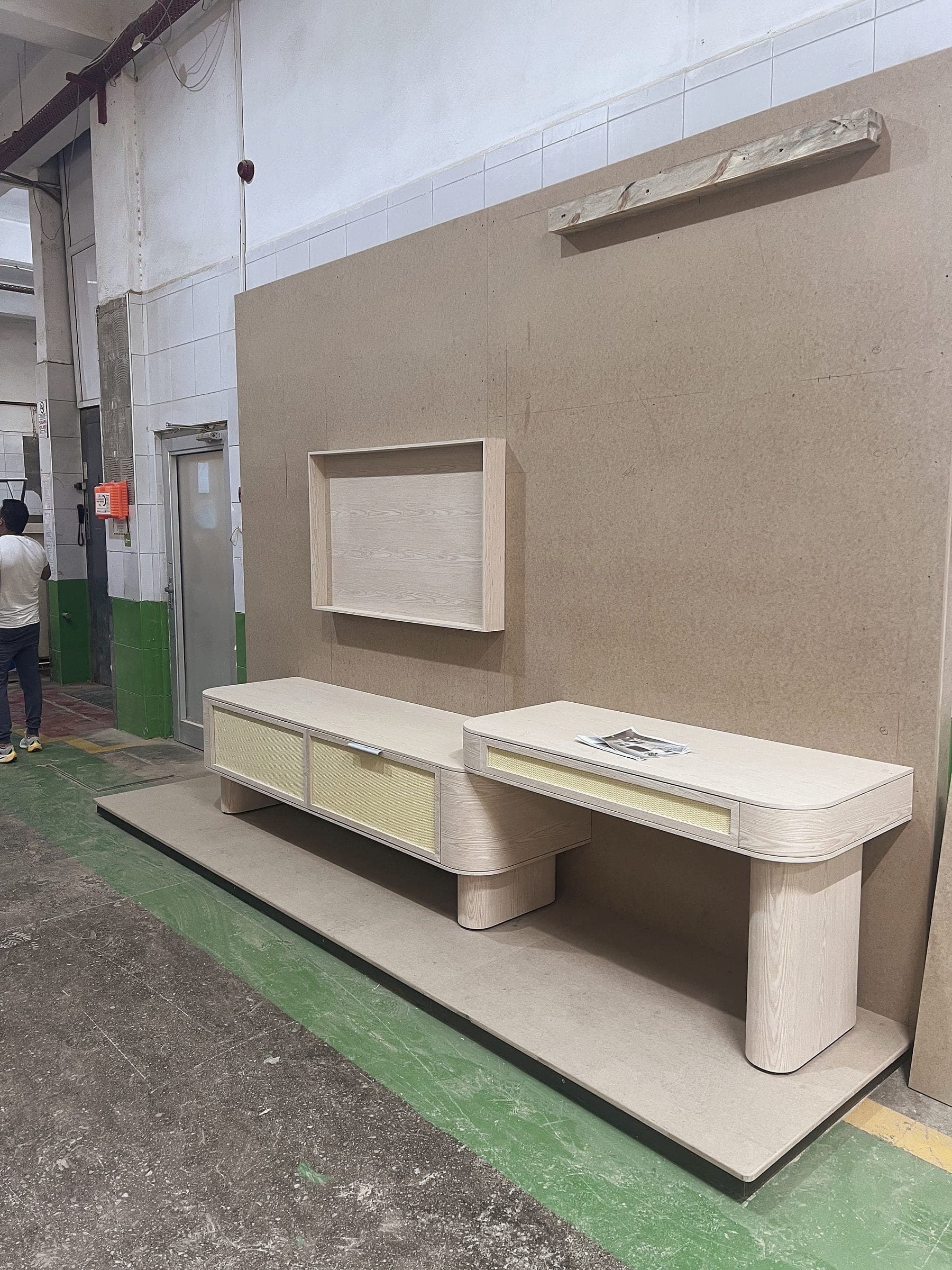
One room decides the rest. Before a guestroom package is released to production a designer reviews the drawings, signs the finishes and walks a room built at full production quality; until that room is signed, nothing gets cut. We keep 8 model rooms in the 350 m² showroom in Gemlik — a room goes up, gets shown, and comes apart again for the next one. This page is that sequence, written in the words the people running the review use.
The seven gates before fabrication
These seven are printed on one real custom-casegoods spec sheet, issued by DLR Group through the College of DuPage invitation to bid. They are checked as a list before anything is fabricated, and a factory that can name all seven has run the process before.
| Gate | What it is | What it decides | Who signs it off |
|---|---|---|---|
| Strike-off | A trial run of a specified pattern on the real cloth or the real surface | That scale, colour and repeat are what was specified, before a bolt is woven or printed | The design team, by stamp |
| Seaming diagram | A drawing of where every seam, welt and railroad direction falls on the piece | How the pattern lands on the finished piece, before any cloth is cut | The design team, against the reviewed submittal |
| Cutting | The cutting ticket, worked against the reviewed seaming diagram and the COM yardage | That yardage, repeat and railroading direction match the specification the cutter works to | The factory, against the reviewed submittal |
| Prototype | One piece built at full production quality, hardware and finish included | Construction, dimensions, comfort and finish, before the run is released | Design team and purchasing agent together |
| Flame certificate | Test evidence on the exact build-up: cover, interliner, filling and frame as assembled | Whether the assembly meets the standard named in the specification | The test house issues the report; the specifier accepts it |
| CFA (cutting for approval) | A snip taken from the actual bolt that will be shipped on the order | That the goods being shipped match the reviewed submittal | The design team, by stamp |
| Transmittal | The cover document: project name, item tag, spec number, reference number, area | Whether the sample is reviewed at all | Raised by the sender; without it nothing enters the review |
What comes back stamped
A submittal does not come back approved. It comes back carrying one of five stamp actions: NO EXCEPTIONS TAKEN, MAKE CORRECTIONS NOTED, REVISE AND RESUBMIT, REJECTED, or REVIEW FOR INFORMATION ONLY. The reviewing designer on the Beloit Procurement Services package states the position in the specification itself: the firm "does not use the term" Approved, and "does not physically sign samples or shop drawings, nor do we approve items into production." The word is missing on purpose. It is a liability position, and it has been one for years.
So the words on our transmittals are "awaiting your review" and "released for production". Using the reviewer's own vocabulary costs nothing and saves a round, and a vendor who asks a US design team for approval has announced that he read the drawings and not the front of the specification.
The same package publishes the review clock: five working days per review round, five more for a resubmittal. Two rounds on a first submittal is ordinary. That time belongs to the design team rather than to the factory, and it is the part of a programme most often missing from a production plan.
A sample only enters that clock if it is legible. The rule, from the same document: "Samples sent without a transmittal, project name, tag, and/or reference number will not be reviewed." An untagged sample is not late, it is binned. Everything that leaves Gemlik carries its transmittal, its item tag and its spec number on the outside of the carton.
CFA is a snip from the bolt that is shipping
CFA is short for cutting for approval, and the word cutting carries the meaning: a piece cut from the actual bolt that will be shipped on this order. A memo sample out of the mill's hanger book is a different object with a different risk, and the specification says whose risk it is. Beloit again: "Cuttings for approval, not from the actual bolt, will be expected to match the provided reviewed submittal."
Where the fabric is COM we ask for the bolt reference and send the cutting from that bolt, so the review runs against the goods that will actually arrive. We ask for the rest of the COM specification unprompted too, because it is what the cutting table needs: exact yardage, railroading direction, pattern repeat and finishing instructions.
Control samples, before any room is built
misch_MISCH put the sequence in one sentence, and the grammar is theirs: "No detail is left out, nor none of the bespoke assembly is allowed to commence until finishes 'control samples', 'strike-off' or 'mock-up samples' for bespoke items are signed off." Sign-off comes first; assembly comes after.
A control sample is the physical reference the run gets judged against afterwards: a finished panel, a stained corner block, a length of the specified cloth. It only works if both sides hold one, so ours are made in pairs and the buyer's half travels. We think a finish photographed under factory lighting is worth very little. The panel goes in the post.
Samples, strike-offs, prototypes and the model room are quoted lines in the package. They are made on the same machines, by the same people, as the order they precede, and they are priced with it. When a substitution is proposed the specification is blunt about who carries the cost of proving it: "Mockups or samples for flame testing will be provided by the manufacturer at their expense." We price that in rather than discover it.
The model room is the benchmark
Alan Benjamin of Benjamin West gives the instruction plainly in CoStar: "First, do at least one model room." Then he says what it is for. "The model room is where the final value engineering process occurs." That sentence is what makes the model room a commercial event rather than a design review, and it is why the cheapest place to change your mind is inside it.
The same article names the other half of the room. "Ensure the purchasing agent is coming with production pricing for each vendor used." A mock-up reviewed without a hard production price per line item has settled nothing, because the value engineering that follows has nothing to price against. When we are in a model room we bring the net price for the run, per item, in writing.
Once the room is signed, the room is the standard. Every unit in the run is measured against it and against the control samples, and the argument at handover is short because the reference is a room somebody stood in.
Two countries of origin, decided at the model room
One firm publishes a recommendation about model rooms that is worth reading before the samples go out. Alan Benjamin and Sarah Churchill of Benjamin West, writing together in Hotel Investment Today: "When the client directs the project team to have items in the model room sourced from a minimum of two vendors per specification/commodity, and ideally from two countries of origin, it allows for multiple options and the ability to pivot as needed."
Read the front of that sentence. It describes what a client directs, not what the market does by default, and we quote it as one firm's published view rather than as practice. Where it is directed, though, the consequence is concrete: the second source is chosen at the model room, not at the production bid, so a factory that is not in the mock-up is not in the run.
That is the place we ask to be. One specification, one net price, in the room, alongside whoever else is in it.
Attic stock, quoted at the same time
Attic stock is the overage held back against damage and against a finish being discontinued, and the figure usually specified is two to five per cent of the run. Real RFQs price it at construction-documents stage, as its own line.
The reason is arithmetic. Matching a stain or a dye lot years after the run has closed costs more than holding the spare did, and on soft goods it is often not possible at all. Quote it with the order or accept the exposure knowingly.
What happens on our side
The floor in Gemlik is 5,000 m² under our own production management, with the 350 m² showroom attached and 8 model rooms. Machining, veneer, finishing and upholstery all happen in the same building, so a finish revision moves through one shop instead of five subcontractors, and the strike-off, the prototype and the control sample come off the same machines as the production run they represent.
We start from your specification and your drawing set. Our drawing office issues shop drawings against it; the submittal goes out tagged and transmitted; the samples follow in the order the spec sheet lists them, not in the order they happen to be ready. Where the specification names a fire standard, the build-up is specified to meet it and the test evidence is issued on that build-up, per specification.
Then the room. It gets built at production quality, lit, and shown: sit on it, pull the drawers out, look at the back of the joinery and at the edge of the veneer. Then it comes apart and the next one goes up in its place. Come to Gemlik and walk one, or take the walkthrough by video with the samples in the post.
Who signs what
The design team reviews and stamps; in the United States they will tell you in writing that they do not approve. The purchasing agent brings production pricing to the room and owns the schedule around it. We make the samples, raise the submittals, build the room, and hold the control samples against the run afterwards. When a question sits outside that split, the answer we give is the one we would want to hear: whose signature closes it, and by when.
Working rooms, built to the day
The model rooms in Gemlik are working rooms. They are built for a project, shown, and taken apart when the next one needs the space, so what is standing on the day you visit depends on the day. Tell us before you come which finish or which piece you need to see and it will be built or on the bench. Photography is the weakest link in this entire process; the sample in your hand is the only version that settles an argument.
Asked most
- What is a model room?
- One or two guest rooms built at full production quality and reviewed before the volume run is released. Everything specified for the room goes into it: casegoods, seating, soft goods, lighting and the fixed joinery. The design team reviews it, the purchasing agent brings production pricing per line item, and the signed room becomes the benchmark the rest of the order is measured against.
- What is the difference between a control sample and a CFA?
- A control sample is the retained physical reference for a finish or an assembly: the panel or block the production run is judged against afterwards. A CFA, or cutting for approval, is a snip taken from the actual bolt of fabric that will be shipped on your order, sent so the review runs against the goods that will arrive rather than against a showroom memo.
- Why does the reviewing designer never write "approved"?
- Because approval carries liability the reviewer will not take. The stamp actions used instead are NO EXCEPTIONS TAKEN, MAKE CORRECTIONS NOTED, REVISE AND RESUBMIT, REJECTED and REVIEW FOR INFORMATION ONLY, and one US package states outright that the firm "does not physically sign samples or shop drawings, nor do we approve items into production." Write "awaiting your review", and "released for production" once it clears.
- Do you send samples and prototypes before an order?
- Send one specification and a net price comes back in writing. The samples, strike-offs, prototypes and the model room itself are quoted lines in the package: they are made on the same machines and by the same people as the order, and they are priced with it.
- How long does the sample and submittal stage take?
- The published clock we can point at is the design team's own: five working days per review round and five more for a resubmittal on the Beloit package, with two rounds on a first submittal being ordinary. Our side of it is the drawing and sample time in front of that, quoted per package as a current estimate against the production plan and reported when it moves.
Related
Specifying a model room?
Send one specification or the guestroom drawing set. A net price comes back in writing, with the sample and submittal sequence listed against it.