
Reference
Who installs it, and what happens if it arrives damaged
Hotel FF&E is usually installed by a specialist installation firm, not by the factory that made it. In the United States that trade is largely the commercial-moving industry: Corrigan Logistics installs FF&E inside the United Van Lines network, Meyer sells it under moving services, BRG Office Movers under office relocation. Where the seller's risk ends is set by the Incoterms rule in the contract, and the claim window closes at receiving.
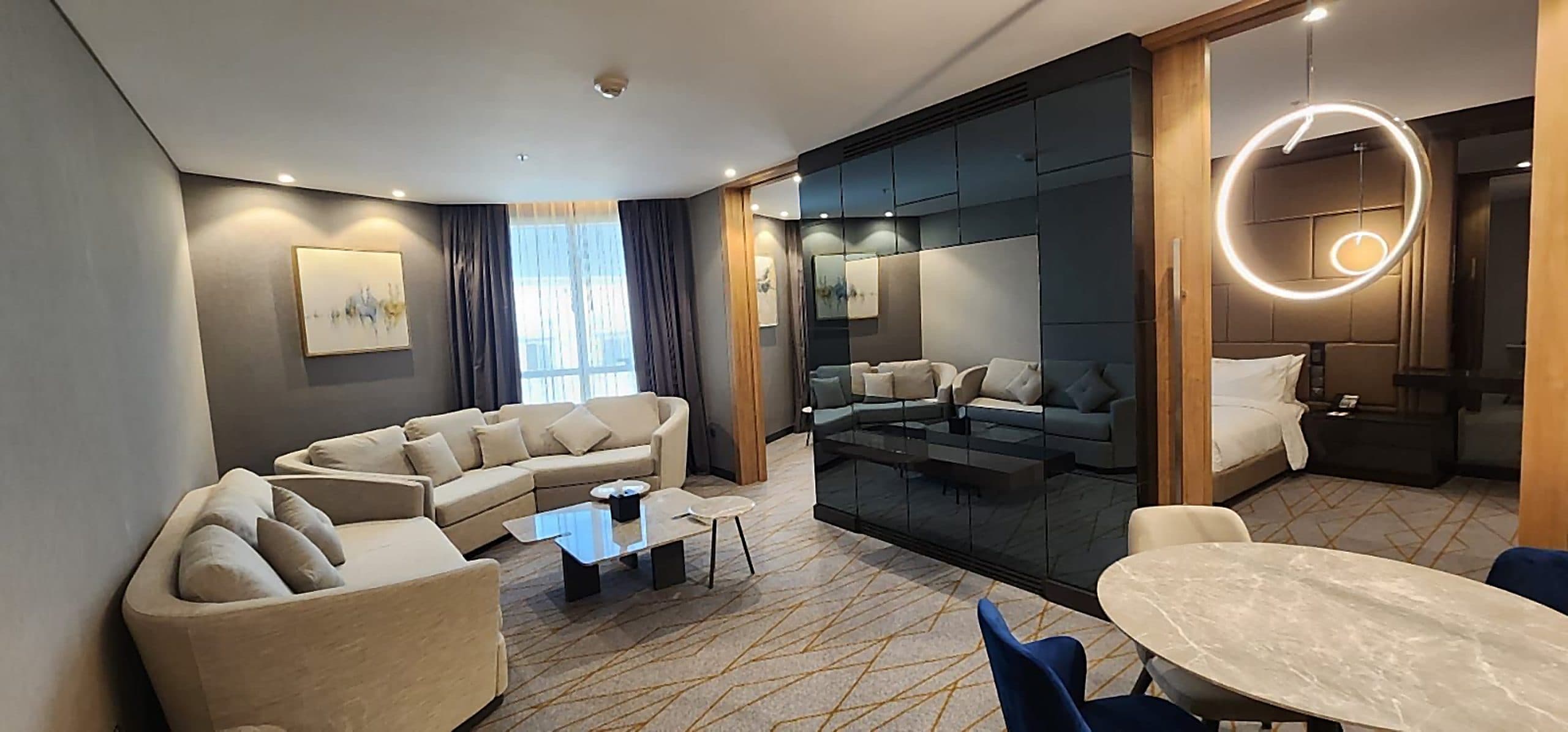
Two questions decide how an imported FF&E package actually lands, and they are usually asked too late. Who unpacks the wardrobe and screws it to the wall, and whose problem is it when the door is scuffed. This page answers both from the documents that govern them: the installers' own service descriptions, the Incoterms 2020 rules, and the two conventions that set the notice period on a damage claim.
Where the seller's risk ends, boundary by boundary
Four of the eleven Incoterms 2020 rules cover almost every hotel FF&E contract. The column that matters on an install is the last one, because it decides who is standing at the delivery address when the crate is opened. Definitions below are the ICC Academy's, the International Chamber of Commerce's training arm.
| Rule | Where the seller's risk ends | Who clears import | Who unloads | What it means on site |
|---|---|---|---|---|
| EXW | At the seller's premises, when the goods are placed at the buyer's disposal. Loading is the buyer's risk and cost | The buyer | The buyer, at both ends | Everything downstream of the factory door is the buyer's to organise and insure. ICC Academy's own note is that traders should consider FCA instead where possible |
| FCA / CIP | When the goods are handed to the carrier at the named place | The buyer | The buyer at destination | Under CIP the seller must insure to Institute Cargo Clauses (A) level, which is all-risk cover rather than the named-perils default |
| DAP | At the named destination, with the goods ready for unloading from the arriving vehicle | The buyer, who also carries the risk during import clearance | The buyer | The truck reaches the property. Somebody on the buyer's side still has to take the crates off it |
| DPU | At the named destination, after the seller has unloaded | The buyer | The seller | The only D rule where unloading is the seller's job. On a site with no dock, that is the difference that matters |
| DDP | At the agreed destination in the buyer's country | The seller; the rule makes it mandatory | The buyer | The seller carries duty and import formalities. ICC Academy advises considering DAP instead, because a foreign seller often cannot act as importer in the destination country |
Who actually installs hotel FF&E
In the United States the answer is mostly the moving industry. Corrigan Logistics sells hospitality installation from inside the UniGroup Logistics Network, affiliated with United Van Lines, and describes the job plainly: “The crews will receive the product on-site, unpackage it, install it in the space and remove any debris.” Meyer sells the same service under a heading of moving services, covering “the full scope, from warehouse receiving through installation, closeout, and the removal of whatever's being replaced.” BRG Office Movers, a division of Beltmann Relocation Group, sells it under office relocation: receiving and inspecting, warehousing, assembly and placement, room-by-room staging, debris removal.
You can check this without taking anybody's word for it. Look at where the FF&E page sits in the firm's own site structure. Meyer files it under moving services; BRG files it under office relocation; Flood Brothers is a commercial relocation company holding over 500,000 square feet of warehouse. Alongside them sit pure-play installers: Precision, Tri-State, The Installers Group in Orlando. The centre of gravity of the trade is still furniture handling rather than furniture making.
Manufacturers who install their own work are the exception, and one of them says so. Artone, a hospitality contract furniture manufacturer, puts it in its own buyer's guide: “Though a rarity in FF&E production, some hospitality contract furniture manufacturers offer installation.” The same guide gives buyers three professional routes: the manufacturer, a firm the manufacturer recommends, or an independent installer. It also suggests holding a reserve of 15 to 25 per cent of the FF&E budget against what the plan did not foresee.
The chain between the container and the room
Between the factory and the finished room there is a receiving step, and it is the step buyers price out first. Freight arrives at a warehouse rather than at the site. Every carton is checked against the purchase order, photographed, logged, and then held until the rooms can take it. Corrigan calls the last part just-in-time site delivery; Flood Brothers calls the whole sequence dock to final placement.
The reason for the warehouse is what happens without one. Flood Brothers, writing about routing freight straight to a jobsite: “An active construction or renovation site usually has no dock, no secure storage, and no one available to receive, count, and inspect freight. Drivers leave pallets on a curb, items walk off, and damage goes unreported until it is too late to file a claim.” Route the same freight through a consolidation warehouse and, in their words, “short shipments and wrong items surface weeks before install, leaving time to reorder”.
The cost of the warehouse is real too, and the buyer-side trade press names it exactly: items “arrive too early and clog the site, too late and stall the install, or are damaged after being double-handled through three storage facilities on the way in”. Every extra handling leg is another chance to scratch a lacquered edge. The judgement is between one storage leg with a proper inspection and three storage legs with none.
The claim window closes at receiving
This is the single most useful sentence in the whole trade, from Lifetime Moving & Storage: “Damaged items that were not caught at receiving cannot be claimed.” Their own protocol is that every delivery is inspected against the purchase order, damage documented photographically and reported within 24 hours, with the item held and the documentation issued for the freight claim. Flood Brothers says the same thing from the other side: damage and shortages are photographed “the day they arrive, while there is still time to reorder”.
The reason is statutory, not commercial. Under the CMR Convention, which governs international road carriage, a consignee who takes delivery without checking the goods with the carrier, and without reservations “not later than the time of delivery in the case of apparent loss or damage and within seven days of delivery, Sundays and public holidays excepted, in the case of loss or damage which is not apparent”, has given prima facie evidence that the goods arrived in the condition the consignment note describes. Non-apparent damage has to be raised in writing.
Sea carriage runs on a shorter clock. Article III rule 6 of the Hague-Visby Rules requires notice in writing at the port of discharge before or at the time of removal, or within three days where the damage is not apparent, and gives one year to bring suit before the carrier is discharged from liability. A crate opened for the first time in week six of an installation programme is outside both windows.
What a carrier actually owes you, and what your policy actually covers
Carrier liability on the road is paid by weight, not by value. CMR Article 23(3) caps the carrier at 8.33 special drawing rights per kilogram of gross weight short. A stone worktop recovers a decent share of its value under that cap; a light, expensive, lacquered wardrobe door recovers very little of its own. Article 23 also values the goods at the place and time they were accepted for carriage and pays nothing for consequential loss, so the idle fitting crew and the room that could not be sold are not in the calculation.
There is a second gap, and it opens at the kerb. The German transport-cargo conditions in general use, DTV-Güterversicherungsbedingungen 2000/2011, end cover at Ziff. 8.2 as soon as the goods are brought to the place the consignee designated at the place of delivery, whether the storage there is provisional, temporary or permanent. A standard transit policy therefore stops when the crate is set down, which can be weeks before the room is signed off. All-risk cover written to Institute Cargo Clauses (A) closes it, and Incoterms 2020 already requires that level of cover under CIP.
Article 17(4)(b) of the same convention gives the carrier a defence of insufficient or defective packing by the sender, which is what a carrier pleads when crated joinery arrives scuffed. That is a reason to pay attention to the crate specification at quotation stage rather than at delivery.
Who is allowed to hold the screwdriver
In several European markets the fitting trade is regulated, and the rule decides the answer before anyone's preference does. In Germany, Tischler appears at Anlage A Nr. 27 of the Handwerksordnung among the trades that may only be carried on independently by a firm entered in the Handwerksrolle, which normally means a Meister, an exemption, or an employed Betriebsleiter who holds one. Firms established in the EU or EEA have a simplified temporary cross-border route into that; a firm from outside it does not.
The practical consequence is that on a German job the installing entity is a licensed German joinery firm, whoever manufactured the furniture. A factory advertising that it flies its own crew in is describing something the receiving country's trade law may not allow. Worth knowing when you search for one: the trade is called Schreiner in the south and west of Germany and Tischler in the north and east, and searching the wrong word misses the local market.
Two responsibilities travel with fixed work regardless of who fits it. On a real US procurement package, field measurements for custom items “are the fabricator's responsibility”, and installation coordination “to ensure items fit in elevators, hallways, doorways” sits with the purchasing agent. Both belong in the contract in writing, because both are discovered expensively.
What the cartons have to say before they leave
A receiving warehouse sorts by what is printed on the outside of the box. A real invitation to bid specifies the sidemark exactly: property name, item name, purchase-order number, spec number and area, printed on the outside of the shipping package. A carton that carries all five gets sorted without being opened; a carton that carries a model code gets opened, and every opening is a handling event.
Knock-down construction is the other packing decision that shows up on site rather than on paper. A wardrobe that ships assembled has to fit the lift, the corridor and the door of the room it belongs to; one that ships flat has to be built in the room by someone with the drawing. Carton dimensions and knock-down construction belong in the quotation, next to the price, because they decide how many people and how many days the install takes.
The list that closes the job is not the factory's either. On the same package the punch list is “a compilation of HBG, procurement agent, owner, and furniture installer's notes” — four parties, one document. Agreeing who compiles it, who signs it and what closing it releases is a five-minute conversation before contract and a long one afterwards.
Eight things to settle before the contract is signed
Which Incoterms 2020 rule applies, with the named place written out in full. Whether the goods go to a receiving warehouse or to the site, and who pays for the storage. Who performs the receiving inspection, on what form, and within how many hours damage has to be reported in writing. Who files the freight claim and against whom.
Whether cargo insurance runs to the installation address or stops at the delivery place, and who covers the gap from unloading to handover. Which entity is legally entitled to install in the destination country. Who takes the field measurements for fixed work and who carries the risk if the shell is out of true. And who compiles the punch list, who signs it, and what its closure releases.
None of these is expensive to agree in advance. All of them are expensive to discover in week six.
How installation runs on our contracts
We manufacture the furniture and joinery in Gemlik and installation is managed by us on site, with the fitting carried out by an established local firm working to our shop drawings under our project manager. On a German or EU job that is the lawful shape as well as the practical one, because the installing entity has to be licensed where the building is. The same person who ran the model room runs the punch list, in English, Arabic or Turkish. Our work is installed in Mövenpick Istanbul, Marriott Belgrade, DoubleTree by Hilton Jeddah and Citadines by Ascott, among the delivered programmes.
How to check every line above
The installer facts come from the installers' own service pages, read on 3 September 2026, and the quickest check is the one described in the first section: look at which part of the firm's own site the FF&E page lives in. The Incoterms definitions are the ICC Academy's, the International Chamber of Commerce's training arm. The notice periods are convention text: CMR Articles 23, 17 and 30, and Article III rule 6 of the Hague-Visby Rules. The German trade rule is Anlage A of the Handwerksordnung. All of it is readable in full online. Where a figure in this trade is quoted without a document behind it, it is usually a rate card, and rate cards move.
Questions we get asked
- Does the furniture manufacturer install the furniture?
- Usually not. Hotel FF&E is normally installed by a specialist installation firm, and in the United States that trade sits largely inside the commercial-moving industry: Corrigan Logistics installs within the United Van Lines network, Meyer sells FF&E under moving services, BRG Office Movers under office relocation. Artone, itself a hospitality furniture manufacturer, calls manufacturer-provided installation “a rarity in FF&E production”.
- What happens if a wardrobe arrives damaged?
- It depends entirely on when the damage is found. Lifetime Moving & Storage states the rule in one line: “Damaged items that were not caught at receiving cannot be claimed.” Under the CMR Convention, reservations must reach the road carrier at the time of delivery for apparent damage and within seven days in writing for damage that is not apparent. Under the Hague-Visby Rules for sea carriage, notice is due at removal or within three days, and suit within one year.
- Should FF&E go to a warehouse or straight to the hotel?
- A warehouse, in almost every case where the site is still under construction. Flood Brothers describes what happens otherwise: a live site “usually has no dock, no secure storage, and no one available to receive, count, and inspect freight”, so “damage goes unreported until it is too late to file a claim”. The counterweight is real: every extra handling leg risks the finish, and warehouses cost money. The aim is one storage leg with a proper inspection rather than three without.
- Who carries the risk while the goods are in transit?
- The Incoterms rule in the contract decides it. Under EXW risk passes at the seller's premises before loading. Under DAP it passes at the named destination with the goods ready for unloading, and the buyer unloads and clears import. Under DPU the seller unloads first. Under DDP the seller must handle import formalities. ICC Academy's own guidance is to prefer FCA over EXW and DAP over DDP where the parties have a choice.
- How much does a carrier pay for damaged furniture?
- Less than most buyers expect, because road carrier liability is calculated by weight. CMR Article 23(3) caps the carrier at 8.33 special drawing rights per kilogram of gross weight short, values the goods as at the place and time they were accepted for carriage, and pays nothing for consequential loss. Article 17(4)(b) also gives the carrier a defence of defective packing by the sender. All-risk cargo cover written to Institute Cargo Clauses (A) is what closes the difference.
- Can a foreign factory send its own fitters?
- Not everywhere, and Germany is the clearest case. Tischler is listed at Anlage A Nr. 27 of the Handwerksordnung as a trade that may only be practised independently by a firm entered in the Handwerksrolle. EU and EEA firms have a simplified temporary cross-border route into that; firms established outside the EEA do not. On those projects the installing entity is a licensed local joinery firm, working to the manufacturer's drawings.
- What should be printed on the cartons?
- The sidemark. A real US invitation to bid specifies it as property name, item name, purchase-order number, spec number and area, printed on the outside of the shipping package, so a receiving warehouse can sort the shipment without opening it. Carton dimensions and whether the piece ships knocked down belong in the quotation too, because they decide whether it reaches the ninth floor.
- Who installs on a Naggarco contract?
- Installation is managed by us on site. The fitting is done by an established local firm working to our shop drawings, under the project manager who ran your model room, and the punch list is closed under our management. Where the destination country regulates the joinery trade, using a locally licensed firm is the only lawful route and it is the one we take.
Related
Send the specification. Get a net price back.
Tell us where it is going and how the site is sequenced, and the quotation will say what is in the crate, what is on the carton and who is standing at the door. We reply within 24 working hours, in English, Arabic or Turkish.