
Reference
Refurbishing floor by floor, while the rooms stay on sale
A hotel refurbishment runs in one of two shapes, and the industry is split between them. A 301-bedroom Delta by Marriott in Bristol was renovated over ten phases with the hotel in operation, according to the project manager at County Contractors. US owners quoted by Hotel Management are going the other way: “we actually come in, shut the hotel down and do it all at once”. The shape changes the whole delivery plan.
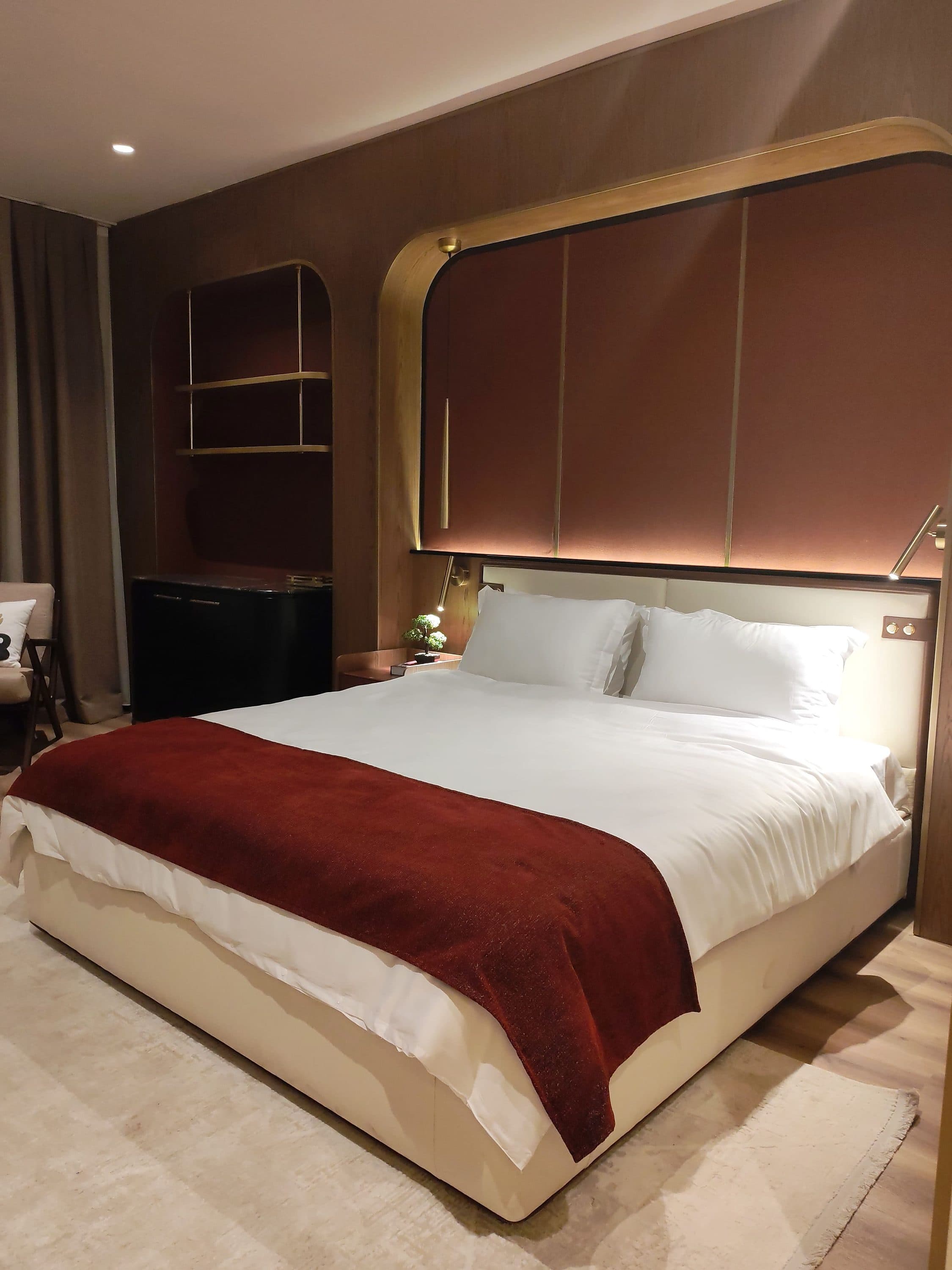
Ask a supplier whether they can deliver in phases and the answer is always yes. The useful question is the one underneath it: which shape is this programme, how many drops does it become, and what happens to everything that was priced as one shipment. This page sets the two shapes beside each other, using what the people running them have said about each.
The two shapes, and what each asks of the package
Neither column is the right answer. They are two different jobs, and a quotation written for one is wrong for the other, which is why the shape belongs in the first conversation rather than in a variation order.
| What changes | Hotel stays open, floor by floor | Hotel closes, one programme |
|---|---|---|
| Who describes working this way | A 301-bedroom Delta by Marriott in Bristol, renovated “over 10 phases whilst the hotel was in operation”, per County Contractors' project manager | US owners in Hotel Management: “we actually come in, shut the hotel down and do it all at once, instead of doing floor-by-floor” |
| The delivery | Several dated drops, each holding a whole floor and nothing more | One consignment, or a short run of consecutive ones |
| Storage | A receiving point that holds later phases while earlier ones install | Less holding, more site space, and everything landing inside one window |
| Customs documents | One proof of origin per consignment, and the shelf life on each becomes a date to track | A single document set, issued once |
| Snagging | A snag list per floor, closed before the floor goes back on sale | One punch list across the property, walked at the end |
| The pressure on the calendar | Rooms out of inventory, and every night one is out is revenue that cannot be re-earned | The whole property out, and a reopening date that does not move |
Both shapes are live, and the market is not agreed
The phased method is the one most European operators describe. County Contractors' project manager David Elliott, on the Delta by Marriott in Bristol: “County worked with Curtis on the recent renovation of 301 bedrooms at the Delta by Marriott in Bristol city centre. The renovation took place over 10 phases whilst the hotel was in operation.” That is a vendor's project page, and worth reading as one, but the shape it describes is the standard European programme.
The standard method inside that shape is top-down. Keith Shugerts, quoted by Hotel Management on overseeing a PIP: “We take a whole floor out, start[ing] at the top of the property, [and] work our way down to the first floor.” The floor is the unit, not the room, because a floor can be isolated for noise, dust and lift access in a way that a scattering of rooms cannot.
The countervailing signal is real and it comes from the same trade title. Miraj Patel, president of Wayside Investment Group: “In fact, we actually come in, shut the hotel down and do it all at once, instead of doing floor-by-floor.” Scott Hammons, on the same page: “Now here's a lot more people saying, ‘Let's get in and out and get all the bang for the buck as soon as we can.’” So a supplier who assumes phasing is assuming.
A floor comes off inventory, not out of order
The vocabulary matters because it is how the revenue side of the hotel thinks about the work. A hotelier on r/askhotels, writing from the front-desk side: “Rooms should not be out of order for renovations; they should be out of inventory.” An out-of-order room is broken. An out-of-inventory room is a business decision with a date attached, and the date is what the FF&E schedule is being judged against.
Modern Hospitality puts the cost of the difference in one line: “In hospitality, a closed room is a liability. It earns nothing, costs to maintain, and every night it stays out of the system is revenue you can't recover.” A delivery that lands a week early does not gain a week. A delivery that lands a week late costs a week of room-nights on every room on that floor.
What phasing does to the delivery plan
One shipment becomes several, and each has to be complete for its floor. That changes packing before it changes anything else: cartons are grouped and marked by phase rather than by item type, so a floor's worth of goods can be released without a warehouse opening boxes to find it. The sidemark carries the area for exactly this reason.
It also changes what proximity is worth. Published haulier tables give 5–7 days door to door by road from Türkiye into Germany, the Netherlands and the UK. A programme running four drops across a season is a different proposition on a road lane measured in days than on a sea lane measured in weeks, because a missed phase can be re-cut and re-sent inside the same month rather than the next quarter.
And it changes where the goods wait. Somebody holds phases two, three and four while phase one installs, and whether that is a receiving warehouse near the property or space inside the hotel is a decision with a cost either way. It belongs in the contract, named, before the first container is loaded.
The paperwork has a clock, and phasing runs it several times
A proof of origin is issued per consignment, so a phased programme raises several. The shelf lives differ by instrument and by destination: an A.TR runs four months from issue, while a EUR.1 for the United Kingdom runs ten months under the revised rules. On a programme that starts in spring and finishes in autumn, a document raised for a phase that then slips is a document that can expire before its container moves.
This is the least dramatic item on any phased programme and one of the most common causes of a stalled floor. The fix is administrative: tie each proof to its own consignment and its own dispatch date rather than raising a set at the start of the job.
Inside one floor, the sequence is fixed
Modern Hospitality sets out the order a room actually gets built in: “Carpet has to be down before headboards go on, joinery has to be in before soft furnishings are dressed, and the final snag walk needs the room functionally complete.” Out-of-sequence delivery, in the same account, “quietly eats two weeks”.
That order is what a phase plan has to be built backwards from. A floor's furniture arriving before its carpet is not early, it is in the way, and it will be moved at least twice before it is installed. The three failure modes named in the same piece are items arriving too early and clogging the site, arriving too late and stalling the install, or being damaged after being double-handled through several storage facilities on the way in.
The arithmetic that catches programmes
Hans Peter Betz, writing on an FF&E schedule that had been approved two years earlier and never updated: “The original commissioning plan called for a three-week snag-and-sign-off window across all 420 keys. At the rate the furniture was moving, that window was going to open with 180 rooms capable of receiving it.”
That is what a phasing plan is for. Not to be gentle with the supplier, but to make the delivery rate and the commissioning rate the same number, floor by floor, so the gap shows up in month two rather than in the handover week.
Five questions that settle the shape
Is the property trading through the works or closing. How many phases, and is the unit a floor, a wing or a room type. Who holds the goods for the phases that are not yet installing, and where. Which dates each phase has to be complete by, and what is on sale the morning after. And who closes the snag list on each floor before it goes back into inventory.
Five answers turn a delivery date into a delivery plan, and they cost nothing to give at enquiry stage. Given late, they arrive as a variation.
How we quote a phased programme
Give us the phase plan with the enquiry and the quotation is built to it: the drops, what each one holds, and how the cartons are grouped and marked so a floor can be released without being unpacked to find it. Installation is managed by us on site, with the fitting done by an established local firm working to our shop drawings under our project manager, and a snag list closed floor by floor rather than once at the end. Gemlik is a road lane into Europe, which is what makes more than one drop practical in the first place. Our work is installed in Mövenpick Istanbul, Marriott Belgrade and DoubleTree by Hilton Jeddah, among the delivered programmes.
Where these accounts come from
The Delta Bristol and the ten phases are County Contractors' project manager, quoted on the furniture maker's own project page, which is a vendor-curated source and is named as one. The top-down method and the shut-it-down counterview are both from Hotel Management, one from a consultant on running a PIP and one from an owner-side panel on capital expenditure. The out-of-inventory line is a hotelier writing from the front-desk side on Reddit, not an owner. The room sequence and the closed-room cost are Modern Hospitality, UK trade press. The 420-key arithmetic is Hans Peter Betz, writing on LinkedIn. Every one of them is a named person or publication you can read.
Questions we get asked
- Can a hotel be refurbished while it stays open?
- Routinely, and the usual unit is the floor rather than the room. A 301-bedroom Delta by Marriott in Bristol was renovated “over 10 phases whilst the hotel was in operation”, according to County Contractors' project manager on the furniture maker's project page. The standard method inside a phase is top-down: Keith Shugerts, quoted by Hotel Management, describes taking “a whole floor out, start[ing] at the top of the property, [and] work[ing] our way down to the first floor”.
- Is it better to close the hotel and do it all at once?
- It is a live option and some owners now prefer it. Miraj Patel of Wayside Investment Group told Hotel Management: “we actually come in, shut the hotel down and do it all at once, instead of doing floor-by-floor”, and Scott Hammons on the same page describes owners wanting to “get in and out and get all the bang for the buck as soon as we can”. Which one suits a property depends on its occupancy, its debt and its reopening date, and it changes the furniture package enough that it should be settled before pricing.
- What does phasing change in the furniture order?
- The number of deliveries, the packing, the storage and the paperwork. Each drop has to be complete for its floor, so cartons are grouped and marked by phase rather than by item type. Somebody has to hold the later phases while the earlier ones install. And because a proof of origin is issued per consignment, a phased programme raises several, each with its own shelf life.
- How many phases should a refurbishment have?
- It follows from the property rather than from the furniture. The published example above ran ten phases across 301 bedrooms. What matters more than the count is that the delivery rate and the commissioning rate match: Hans Peter Betz describes a plan whose three-week sign-off window across 420 keys was going to open with only 180 rooms ready to receive it.
- What is the difference between out of order and out of inventory?
- An out-of-order room is broken. An out-of-inventory room has been deliberately withdrawn from sale, usually for works, with a date to come back. A hotelier on r/askhotels puts the rule plainly: “Rooms should not be out of order for renovations; they should be out of inventory.” Using the right one signals that you understand install days are revenue days.
- In what order does a guestroom get finished?
- Modern Hospitality sets it out: “Carpet has to be down before headboards go on, joinery has to be in before soft furnishings are dressed, and the final snag walk needs the room functionally complete.” Delivery that arrives out of that sequence, in the same account, “quietly eats two weeks”.
- Do the customs documents change on a phased delivery?
- The instruments do not change; the number of them does. A proof of origin is raised per consignment, and the shelf lives differ: an A.TR runs four months from issue and a EUR.1 into the United Kingdom runs ten months under the revised rules. On a long programme a phase that slips can outlive the document raised for it, which is why each proof should be tied to its own dispatch date.
Related
Send the phase plan with the drawings.
Tell us how many drops, what each floor holds and when it goes back on sale, and the quotation will be built to that shape. We reply within 24 working hours, in English, Arabic or Turkish.